Introduction
Class 12 board exams end. The results come out. And almost immediately, a question arrives that feels enormous.
What now?
For a long time, the answers felt limited. Engineering or medicine. Pick one, work hard, and you will be okay. This is what a lot of families believed, and in reality, it worked for many people. Those are still solid paths.
But if you look at the world that actually exists today, the story is considerably more interesting than that.
There are students building careers in fields that did not exist a decade ago. Industries are growing faster than the traditional ones. There are young professionals doing work that is both genuinely meaningful to them and financially rewarding, in areas their parents had never heard of when they were making their own career decisions.
A real career guide after 12th should show you that landscape honestly. Not just the two paths everyone talks about, but the full range of what is available, what is growing, and what might actually fit who you are.
Why Are Students Looking Beyond Engineering and Medicine?
This is worth understanding clearly, because it is sometimes misread as students becoming lazy or uncommitted. That is not what is happening.
Engineering and medicine are still excellent career choices for students who genuinely want them. The demand for engineers and doctors is real and ongoing. But something has shifted in how students are approaching their choices.
More students today want a career that aligns with who they actually are. Their interests, their strengths, the kind of work they find genuinely engaging rather than just tolerable. They are watching people build careers in creative fields, in data, in psychology, in business, in design, and seeing that those careers are both fulfilling and financially viable. And they are asking why they should choose something they do not want simply because it is familiar.
A good career guide after 12th starts with this question. Not what is the safest choice or the most prestigious one, but what are you actually good at, and what kind of work could you see yourself doing for a long time without feeling like you are just enduring it?
That is a harder question. But it is the right one.
What Career Options Actually Exist Today?
The honest answer is more than most students realise when they are sitting at the end of Class 12.
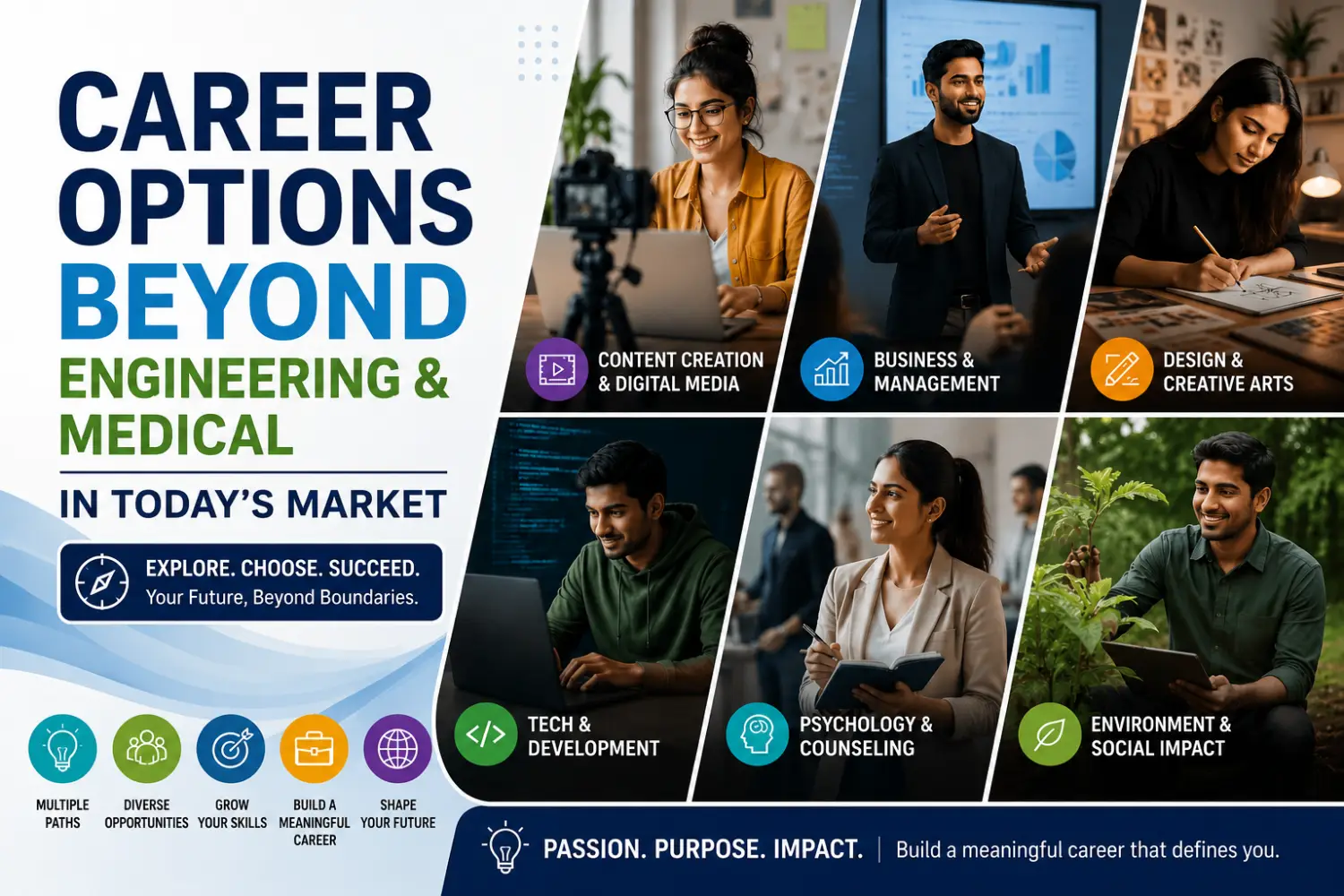
If you are drawn to business and management, a BBA or B.Com can open doors into corporate management, finance, marketing, and entrepreneurship. These are fields with consistent demand and clear paths for growth.
If you enjoy understanding how people think and what drives human behaviour, psychology is one of the most rapidly growing fields in India right now. Clinical psychologists, counsellors, organisational psychologists, and researchers are all in genuine and increasing demand as mental health awareness grows across the country.
If law interests you, legal careers extend well beyond courtrooms. Corporate law, policy work, human rights, international law, and compliance are all areas where trained lawyers are needed and well compensated.
If you are creative and enjoy storytelling, media, content creation, design, and digital communication are industries that are expanding fast and paying seriously for skilled people. The rise of digital platforms has created enormous demand for people who can create compelling content and manage online presence.
Environmental science and sustainability are fields where the combination of growing public awareness, regulatory change, and corporate responsibility is constantly creating new professional roles. Students who enter this space now are building careers in an area that will only become more important.
Biotechnology, hospitality, data analytics, digital marketing, and entrepreneurship are all areas with strong and growing employment landscapes that were barely on the radar for students finishing Class 12 a generation ago.
A career guide after 12th that only points you toward two options is not giving you the full picture.
How Do You Actually Choose the Right Path?
This is where a lot of students get stuck. The options feel overwhelming when you have spent most of your life focused on a narrow set of academic goals.
Here is a useful way to think about it. Instead of asking what career will make you the most money or what will impress the most people, ask three simpler questions.
What do you genuinely enjoy doing, even when no one is watching or grading you? What are you better at than most people you know? And what kinds of problems do you find interesting enough to want to understand more deeply?
Where those three things overlap is usually where a satisfying career lives.
If you enjoy working with numbers and understanding why markets move the way they do, economics or finance might be the right direction. If you find yourself naturally drawn to helping people navigate difficult situations, psychology or counselling might be worth exploring. If you have always enjoyed building things, whether physical or digital, engineering or design could be the right fit.
The point is not to find a perfect answer immediately. It is to stop treating the decision as if there is only one correct path and start treating it as genuine exploration.
A career guide after 12th should give you the language and the framework to do that exploration well.
What Skills Matter No Matter What You Choose?
Here is something worth knowing early. The specific field you enter matters. But the underlying skills you develop matter more than people usually acknowledge.
The ability to communicate clearly, in writing and in person, is valuable in every single professional context without exception. Whatever you study, take this seriously.
Critical thinking, the ability to look at a situation, identify what is actually happening, and reason through it systematically, is what separates people who are genuinely useful from those who are just technically qualified.
Adaptability matters more than ever. Industries are changing fast. The specific tools and technologies in any field will look different in five years from how they look today. The people who do best over a long career are the ones who can learn continuously, not the ones who have mastered one fixed skill set.
Digital literacy, the comfort to learn and use technology as it evolves, has become as fundamental as reading and writing. No career is completely insulated from the impact of digital transformation.
And finally, the ability to work well with other people, to listen, to collaborate, to handle disagreement constructively, turns out to be one of the most practically important things in almost any professional environment.
A career guide after 12th that focuses only on subject knowledge and ignores these broader capabilities is leaving out a significant part of what actually makes someone successful.
Why Is Right Now a Particularly Good Time to Explore?
The job market students are entering today is genuinely different from the one their parents navigated.
Digital marketing, business analytics, content creation, sustainability consulting, data science, UX design, and dozens of other roles are growing faster than traditional industries and, in many cases, paying better. These are not niche opportunities. They are mainstream careers with clear paths for advancement.
The students who start understanding this landscape early, who choose their education with some awareness of where these fields are heading and what skills they require, arrive at their first job with a significant head start.
This is not about chasing trends. It is about making an informed choice rather than a default one.
Why Is SRM University Delhi-NCR, Sonepat Worth Considering?
Choosing a university is a decision that shapes the next several years of your life in concrete ways. The education you receive, the people you meet, the professional exposure you get, and the habits of thinking you develop all come out of that environment.
SRM University Delhi-NCR, Sonepat, SRMUH, offers programmes across management, law, commerce, psychology, hospitality, science, and technology. The emphasis across all of them is on combining solid academic foundations with practical, real-world application. Industry-oriented teaching, access to experienced faculty, and genuine support for student career development are central to how the university operates.
For students who are trying to navigate all of the choices that come after Class 12, SRMUH offers an environment where that navigation is taken seriously. You are not just a student completing a programme. You are someone building a future, and the university is invested in that process.
What Should You Actually Do With This?
The most important thing to take away from this is that you have genuine choices.
You do not have to follow the path that seemed obvious when you were in Class 10. You do not have to choose a career because it is what everyone expects or because it is the safest-sounding option. You do not have to have your entire future figured out right now.
What you do need to do is approach this decision with curiosity and honesty. Be honest about what you enjoy and what you are good at. Be curious about fields you have not explored yet. Be willing to gather real information rather than making assumptions about what different careers look like.
A real career guide after 12th does not narrow your choices down to one right answer. It opens doors and helps you walk through the ones that make the most sense for who you actually are.
That journey belongs to you. Start it with your eyes open.

