
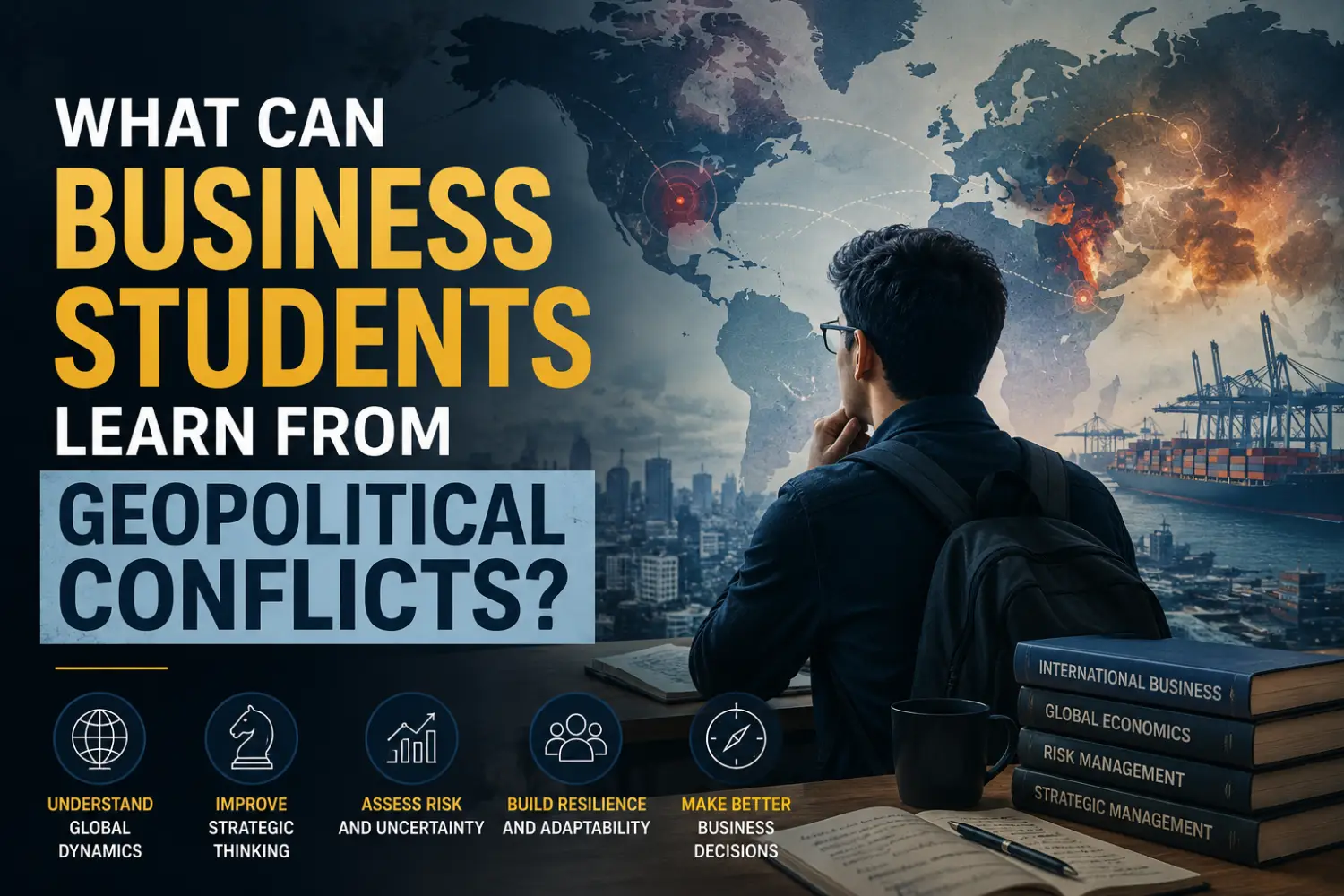
Introduction
Imagine this. You wake up, grab your phone, and find a headline about a war breaking out in some corner of the planet. You scroll down. You prepare your tea. And life goes on.
But for the supply chain manager sitting in an office somewhere, that headline isn’t mere news. It’s a significant problem they have to tackle by the end of the day. Shipments are in jeopardy. Suppliers are inaccessible. The prices are moving already.
That is the reality of conducting business now in the world. And that is something that every commerce student must understand very well. Geopolitical disputes don’t remain behind TV screens. They walk into boardrooms, into balance sheets, into commercial choices.
Students who are searching for the best colleges in India for commerce should focus on institutions that provide real-world business exposure.
How Do Geopolitical Conflicts Actually Affect Supply Chains?
Let me paint you a picture.
A clothing manufacturer in India receives its fabric from a country that suddenly becomes political. Within days, the shipments cease. The cloth, originally scheduled for shipment last Tuesday, now remains in a port with no clear timeline. Silence falls on the industrial floor. The orders are piling up. Clients start calling.
This scenario is not a textbook case study. This same tale has played out in similar versions with oil during tensions in the Middle East. This situation is similar to the issue of computer chips in the U.S.-China trade war. The situation regarding wheat and sunflower oil has changed since the beginning of the Russia-Ukraine conflict.
The lesson here is unpleasant but important. No business, no matter how well handled, is immune to what happens in the environment around it. A disruption occurring thousands of kilometers away can reach your doorstep more quickly than you anticipate.
Many of the best colleges in India for commerce students use real industry case studies to build decision-making skills. They are involved in real situations. They show students how things unraveled exactly and what firms did to survive. Because now the subject is not optional to grasp. That’s all part of the job.
Why Is Risk Management Such an Important Skill?
When most individuals hear the word “risk,” the purpose is to avoid it. It is understandable. But it’s also wrong.
There’s always risk. The point is to acknowledge its existence. The idea is to perceive it clearly before it surprises you.
Consider what a business that is prepared really does. It doesn’t depend on one source. There are two or three choices in different fields. If one of the sources doesn’t pan out, the whole operation doesn’t fall apart.
It also tracks currency moves. A rapid change in currency rates might subtly erode a business that earns in dollars and spends in rupees. The corporations that watch these changes are spared severe surprises at quarter-end.
And then there’s the practice of simply noticing. Keeping up to date with political developments in the countries you do business with. They actively seek out signs of instability. Asking Difficult Questions Before They Become Urgent
Commerce students with this perspective are really different from the kids who do not grow up with this mindset. They enter into a business setting and immediately start asking, “What could go wrong here, and what’s our plan if it does?” Selecting the best colleges in India for commerce students can help them develop strong risk management skills.
How Do Successful Companies Adapt During a Crisis?
Here’s something that may surprise you. The corporations that came out of historic crises in the strongest position weren’t always the biggest or the richest. They were the most adaptable.
Some companies transferred their manufacturing surreptitiously elsewhere when trade routes were down. When lockdowns impacted physical retail, some companies created online operations virtually immediately. When one market became inaccessible because of sanctions, some enterprises found whole new clients in places they never thought to look.
This is not glamorous. It’s a demanding, uncertain job. Nobody was confident at the meetings. They were making decisions on the hoof, under real pressure, hoping they had read the situation well.
But here’s what made the difference. Those companies that adapted had already been thinking this way. They asked the “what if” questions before the crisis hit. And so when the time came, they were not beginning from scratch.
This is one of the most essential things you can learn as a commerce student. The world will not remain predictable. Markets change. Governments change. Technologies disrupt whole industries. The one skill that will be more useful to you than most is the ability to think clearly when things go fuzzy.
The best colleges in India for commerce students motivate students to understand how geopolitical events can majorly impact businesses.
How Do Conflicts Change the Way Businesses Handle Money?
When a geopolitical battle breaks out, its consequences extend beyond the borders. They go immediately into financial markets.
Investors get antsy. They start withdrawing money from hazardous regions and putting it into safer places. It sounds abstract until you see what it implies in practice. Stock markets in the impacted areas declined. Currencies tumble. It becomes more expensive to borrow. And businesses that were planned to expand suddenly find the numbers no longer add up.
This puts a very special kind of pressure on a company that works internationally. You could be making gains in a currency that has just lost value. Maybe your raw material costs are going up because worldwide prices have shot up. The bank ready to lend you money last month is asking tough questions now.
Students searching for successful careers often opt for the best colleges in India for commerce students because of their industry-oriented approach.
There’s a technique to learning how to navigate this field. It’s just practice and exposure. That’s why commerce programs using real case studies and not just theoretical models create better-placed graduates. SRM University, Delhi NCR, Sonepat, immerses students in real-life financial circumstances, where businesses must make tough judgments under duress. That encounter affects your thinking. Textbooks offer you the basics. Real situations offer judgment.
Why Does Global Awareness Matter So Much for Commerce Students?
Until recently, an understanding of foreign events was an advantage. A plus. Good to have, but not needed.
That view has not aged well.
Today, a legislative decision in Washington might impact a little textile business in Surat. Tensions between two countries on the other side of the world can cause the cloud costs of a Bengaluru firm to change. Mumbai traders need to know what a central bank in Europe is doing and why.
The world is so connected now. And the students who get this have a big leg up on the ones who don’t.
You don’t have to be a foreign policy specialist. That’s not the point. The objective is to create the habit of looking outward. Asking how the happenings in the world are related to the business decisions you are making. Interest in the world beyond your immediate market.
Modern business education in the best colleges in India for commerce students goes beyond theoretical learning.
This is something the best institutions in India for business students take seriously. They bring current happenings into the conversations. They foster broad reading and a global perspective in students. They help you connect what’s occurring out there to what it means for businesses on the ground.
How Can the Right College Actually Prepare You for All This?
That’s a question worth pondering before deciding where to study. Is the actual world the classroom of the colleges?
The best colleges in India for commerce students help learners adapt to rapidly changing global markets.
Because the pupils who leave most prepared are not the ones who got the greatest scores on theoretical exams. They’re the ones who learned to sit with uncertainty and nonetheless make a decision. Who can look at a tangled, complex situation and locate the thread that matters? Who would have thought that business is not only numbers on a page but human judgments made under duress?
That is what you learn when you genuinely study geopolitics and business together.
This is what SRM University, Delhi NCR, Sonepat is made of. The program is not just about lectures and tests. Students learn using real case studies, work with industry specialists, and gain skills that are actually practical from the first day on the job. It’s not simply about what you know. It is about how you think.
Anyone who is looking for the best institutions in India for commerce should ask this simple question. Is this institution going to prepare me for the real world?
What Does All of This Mean for Your Future?
Geopolitical disputes aren’t going anywhere. The world is becoming more complicated, if anything. More connected. More unpredictable
The pupils who take this seriously today are the ones who will be ready when it counts. They will spot a risk early and act before it becomes a disaster. They will bend when the circumstances change, not break. They will make sound financial decisions even while the ground shifts under them.
Before applying, students must evaluate whether the best colleges in India for commerce students provide practical business exposure.
And really, that is the most crucial thing you can pick when you choose where to study.

