
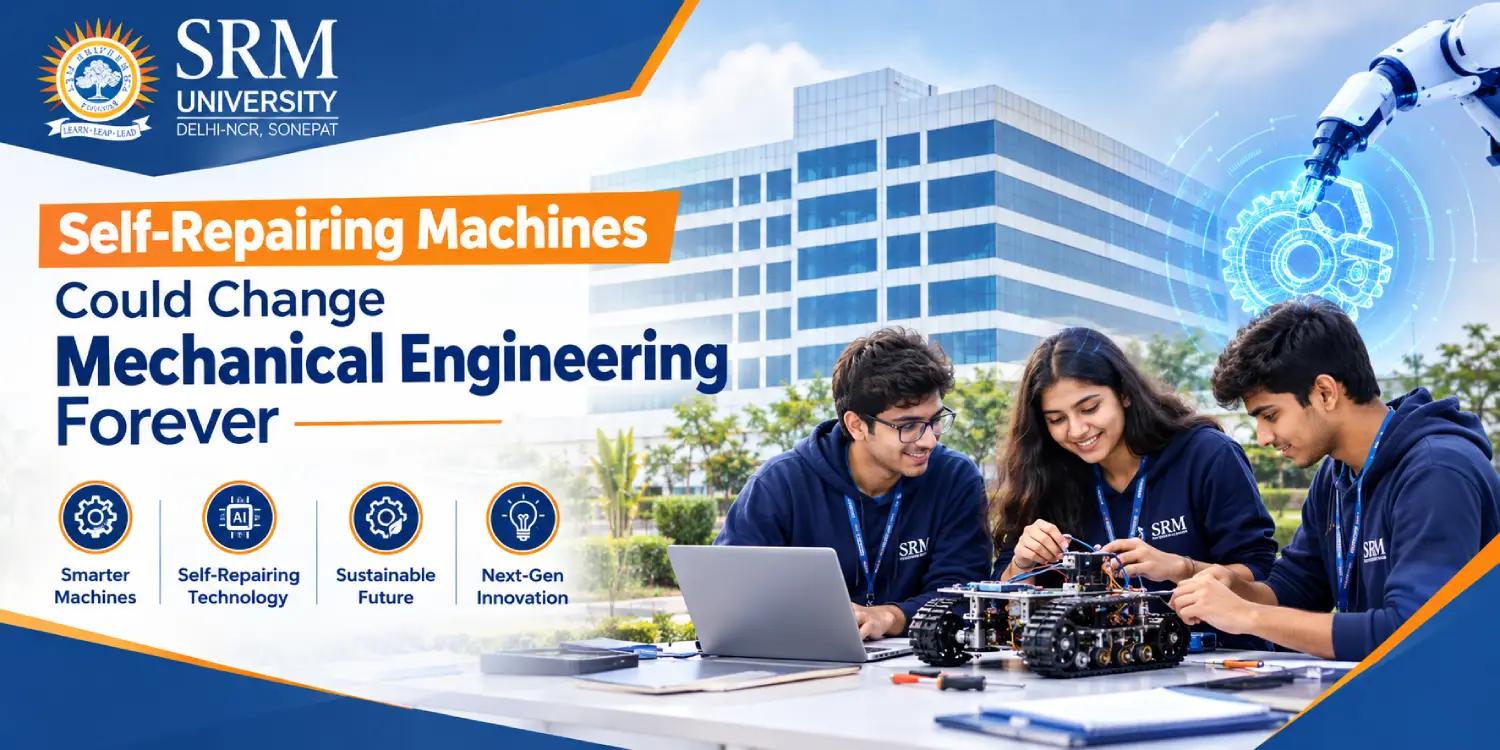
Rohit’s father ran a small workshop, fixing machines used in factories. One machine would break down every week, and workers would wait for hours until it was repaired. Rohit had watched this pattern repeat itself throughout his childhood. One day, his lecturer showed the students a video of a machine that could detect its own break and seal it automatically using a unique self-healing substance. Rohit couldn’t get it out of his mind. If machines could heal themselves, his father’s business model could shift altogether. This concept made Rohit look more closely at mechanical engineering colleges in India, hoping to locate one that genuinely taught this kind of futuristic, self-repairing technology. He first started off with a generic online search for good mechanical engineering colleges in India, and then steadily filtered down his choices based on what each college actually taught in its labs.
What Are Self-Repairing Machines, and How Do They Actually Work?
Self-repairing devices are constructed from unique materials and sensors that can identify and mend damage autonomously, eliminating the need for a human technician on each occasion.
- Some materials have microscopic capsules of healing fluids embedded, which are released when a break forms.
- Sensors on the machine continuously assess stress and wear.
- Smart software can forecast a fault before it becomes a serious problem.
- Some designs include tiny robotic components that repair worn sections on their own.
This is not science fiction anymore. It is becoming a real study topic and is progressively finding its way into modern mechanical engineering curricula. More and more students are questioning if such advanced topics are in the syllabus of good mechanical engineering institutes in India. Many of these pupils now think of this one inquiry as their first actual filter while they shortlist any good mechanical engineering institutions in India.
| Technology | What It Does | Importance for Future Mechanical Engineers |
|---|---|---|
| Self-Healing Materials | Repair cracks or damage through chemical or physical mechanisms | Helps engineers design components with longer service lives |
| Sensors & Condition Monitoring | Detect stress, vibration, temperature and material damage | Enables continuous monitoring of machine health |
| Predictive Maintenance | Uses sensor data to identify potential failures before breakdown | Reduces unexpected downtime and repair costs |
| Robotics & Automation | Performs inspection, maintenance or repair tasks with limited human intervention | Builds skills for automated industrial environments |
| AI & Machine Learning | Analyses machine data and predicts faults or maintenance needs | Supports smarter maintenance and engineering decisions |
| Digital Twins | Creates a digital representation of a physical machine or system | Allows engineers to simulate performance and potential failures |
| Advanced Manufacturing | Uses technologies such as additive manufacturing to produce or replace components | Enables faster and more flexible component development |
| Smart Materials | Respond dynamically to environmental or mechanical conditions | Opens new possibilities in adaptive machine design |
Why This Technology Could Change Mechanical Engineering Forever
Mechanical engineering is the branch of engineering concerned with the design, construction, and maintenance of machines. Self-repairing technology changes the maintenance aspect totally.
Reduced Downtime for Factories and Industries
- Every time a machine breaks down, factories lose a lot of money.
- Self-repairing systems can cut this downtime considerably.
- Workers spend less time doing emergency repairs and more time really producing.
- This immediately improves efficiencies across entire sectors.
New Tool Kit for the Engineers of Tomorrow
- Engineers will have to learn about smart materials, not simply ordinary metals and alloys.
- Sensor technologies and predictive maintenance will be the fundamental abilities.
- Basic coding and data literacy will be more important than ever.
This shift is why the top mechanical engineering institutions in India are changing their laboratories and curricula slowly. The top mechanical engineering colleges in India are moving fast to catch up, since faculty at these universities often say this shift took even them by surprise.
How Are Mechanical Engineering Courses Preparing Students for This Shift?
A standard mechanical engineering program would cover topics like thermodynamics, machine design, and production processes. These issues will always be important. But they are being added on top of new topics.
- A few colleges now offer modules on smart and self-healing materials.
- Robotics and automation are now a major aspect of many programs.
- Sensor-based monitoring systems are increasingly being taught in traditional design disciplines.
- Industry-linked labs are assisting students to build and validate these innovative concepts.
This shows that the mechanical engineering courses in India today are trying to stay relevant by mixing the ancient basics with truly innovative, forward-looking technologies. It also tells you why the structure of engineering courses in India appears so different today than it did only five years back.
So why should students care about this shift right now?
After the video, Rohit’s professor mentioned something IMPORTANT. Students who understand self-repairing systems today will likely operate the factories of tomorrow.
- Companies are already investing in predictive maintenance and smart manufacturing.
- These new notions are needed by engineers in current industries.
- This tendency is rapidly spreading mainly in automobiles and heavy machinery.
- The appropriate college choice today can directly impact how future-ready a student’s skills will be tomorrow.
That is why more students and parents are comparing good mechanical engineering institutions in India on how forward-thinking their curriculum really is, as opposed to their entire reputation.
What is the Reason for Which Students Should Check While Selecting a College?
- See if the college has any robotics, automation, or smart materials laboratories.
- See if academics are working on or teaching emerging trends in mechanical engineering.
- Seek out relationships with companies for actual industry exposure.
- Look at the placement records relevant to modern manufacturing and automation jobs.
These considerations become quite important when comparing mechanical engineering institutions in India, as exposure to modernity might differ a lot even in colleges with similar course names. Spend significant time on this step, instead of skimming through a list of mechanical engineering colleges in India based on name familiarity alone.
| College Feature | What Students Should Check | Why It Matters |
|---|---|---|
| Robotics & Automation Labs | Industrial robots, automation systems and hands-on projects | Builds experience with automated manufacturing |
| Smart Manufacturing Facilities | CNC, industrial automation, sensors and connected systems | Prepares students for Industry 4.0 workplaces |
| Materials Science Exposure | Smart, composite or advanced materials laboratories | Supports understanding of emerging self-healing technologies |
| Sensor & IoT Training | Sensors, condition monitoring and data collection | Develops predictive-maintenance skills |
| AI & Data Skills | Machine learning, analytics or programming electives | Helps engineers interpret machine-health data |
| Industry-Linked Centres | Centres of Excellence and partnerships with manufacturers | Provides access to industry practices and equipment |
| Live Projects | Projects involving robotics, automation, maintenance or manufacturing | Converts theoretical knowledge into practical experience |
| Internships & Placements | Opportunities with automotive, manufacturing, robotics and industrial firms | Helps students apply emerging engineering skills professionally |
How Do You Compare Different Colleges On This Front?
- Much attention is paid to smart systems and automation. Compare the entire subject list of shortlisted mechanical engineering courses in India.
- See if the university has dedicated centres created with real industrial partners.
- One such aspect that differentiates the best mechanical engineering colleges in India from the rest is the placement results, especially for students trained in modern manufacturing regions.
- Discuss with alumni or current students how current their real classroom learning appears, as this honest feedback usually tells more than official rankings of mechanical engineering institutes in India.
This kind of rigorous comparison helps students steer clear of applying to a college that may look great on paper.
SRM University, Delhi-NCR, Sonepat, Haryana: A Closer Look
SRM University Delhi-NCR Sonepat is one of the good mechanical engineering colleges in India and should be on the list of students who are looking for solid options.
- It provides specific B.Tech Robotics and Automation, core B. Tech Mechanical Engineering and M.Tech Production Engineering programs.
- The Department of Mechanical Engineering has established three Centres of Excellence with real industry partners, namely the ACMA Center with the Automotive Component Manufacturers Association, the SRM-BOSCH Center, and the SRM-Siemens Center.
- The centres give students hands-on experience with real, industry-grade automation and manufacturing tools — the exact kind of instruction future self-repairing systems will require engineers to grasp.
- SRM is ranked AAAA+ by Careers360 amongst the top universities in North India.
- 50+ international and industry collaborations help to provide up-to-date, industry-relevant learning.
- Placement support is extremely strong, with 925+ firms visiting the school, 2,024+ positions placed, and 1,400+ paid internships offered across programs.
- The campus, spanning 47.89 acres in Rajiv Gandhi Education City, provides students with the right infrastructure to concentrate on classroom instruction as well as actual lab work.
If you are a student looking for good mechanical engineering colleges in India, SRM University Delhi-NCR Sonepat stands out for its dedicated Robotics and Automation program combined with three actual industry Centres of Excellence. These give students real, hands-on experience with the smart, automated systems that are shaping the future of mechanical engineering.
Conclusion
Self-repairing machines are a new technology, yet they point to the future of mechanical engineering. Future engineers will need to understand smart materials, sensors, and automation, not just traditional design and manufacturing. Be it the top mechanical engineering colleges in India or comparing various mechanical engineering courses in India, always assess how concerned a college is about this trend toward smarter, self-maintaining machinery. And the right option today could lead to a truly interesting engineering job tomorrow. Before you make your final decision, take the time to actually visit a number of shortlisted mechanical engineering colleges in India and sit in on a class.
Frequently asked questions (FAQ’s)
1. Are there self-repairing machines in real industries today?
Some early versions are available in research and specialised applications, in particular in materials science and aerospace. Wider industrial uses are still in development but steadily rising.
2. Do I have to study materials science separately to comprehend self-healing technology?
Not always. The main or optional sections of many mechanical engineering programs now include smart materials; therefore, a separate degree is not normally necessary. This is another reason why it is so important to compare mechanical engineering courses in India subject-wise.
3. Will this change diminish the importance of traditional mechanical engineering subjects?
No. Subjects like thermodynamics, machine design, and manufacturing are still required. Self-repairing technology builds on these basics, adding new skills rather than replacing them.
4. What are the signs of a college investing in these emerging mechanical engineering trends?
Search for dedicated labs, industry-linked centers of excellence, updated electives, and academics working in relevant research or industrial projects.

