
Introduction
When you think of a hotel, you probably think of something calm. A dimly lit lobby. A room to breathe at the end of a long trip. A place built entirely on comfort and welcome.
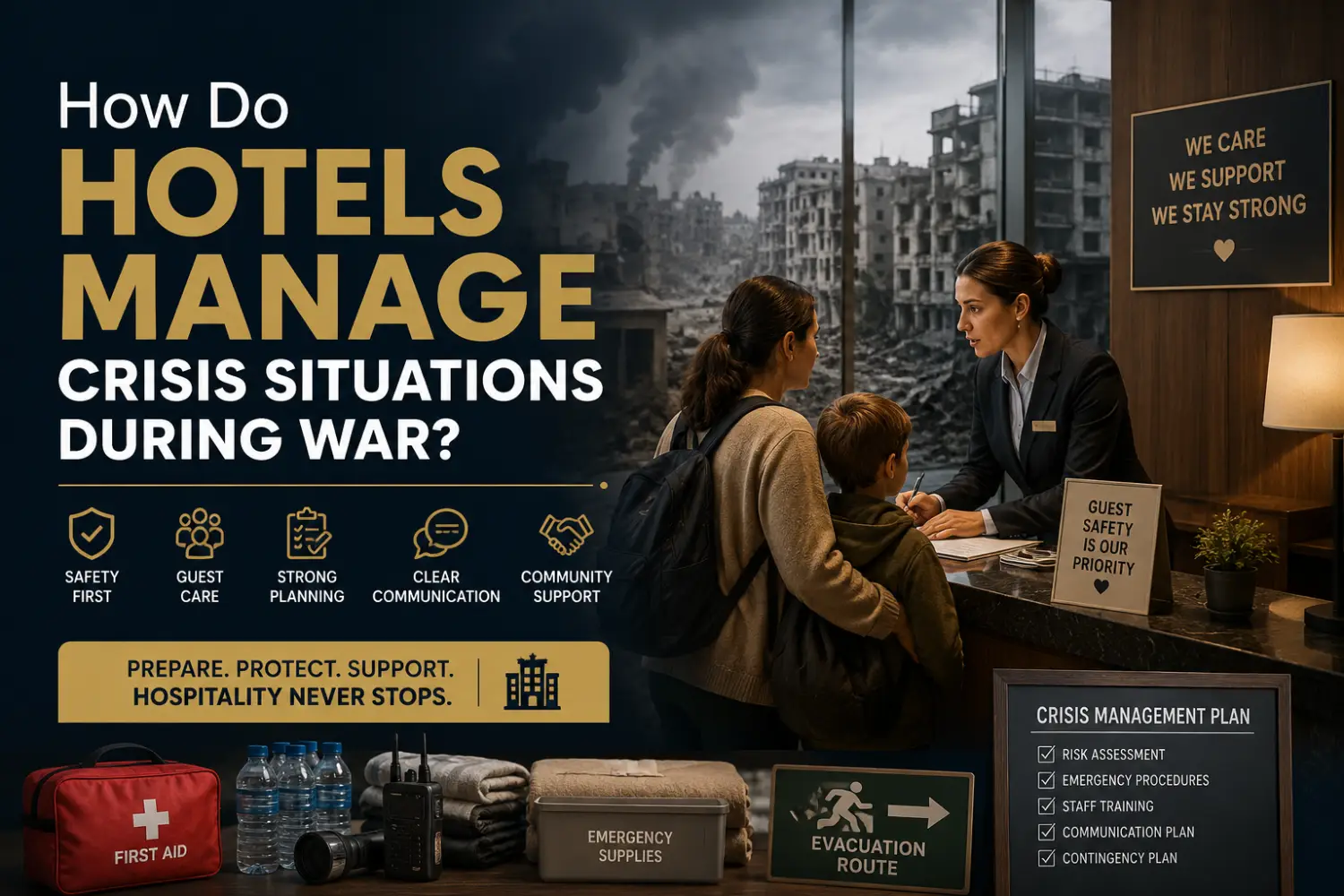
But now think of the same hotel in a city where there is a war happening.
Outside, the streets are tentative. The guests are scared. The supply deliveries are over. Some personnel can’t get to work. And the people inside, whether they are travellers, journalists, aid workers, or officials, are relying on the hotel to keep them safe.
That’s a whole different kind of challenge. And the pros who rise to meet it don’t improvise. They are using training, planning, and a deep understanding of how to lead in a time of instability.
Students earning a B.Sc. in hotel management and catering technology are learning more and more about this side of the industry. Because hospitality is not only for good days. It’s also about preparing for the hardest ones.
What Kinds of Challenges Do Hotels Face During a War?
The challenges arrive quickly, from all directions at once. It’s what makes a wartime crisis so hard to deal with.
The most immediate concern is safety. When a conflict breaks out near a hotel, there is a real danger to the safety of guests and staff. There may be threats in the surrounding area, property damage, or situations that require rapid decisions as to whether people need to move or shelter in place.
Meanwhile, the supply chains that hotels rely on daily start to unravel. The regular supply of food, water, cleaning, and basic goods slows down or stops completely. Hotels that were stocked for normal operations now have tough choices to make about what they have left and how long it needs to last.
Staffing is another serious pressure. Some employees live far away or in areas that are too dangerous to travel from. Other people have families to look after and can’t come in. When a hotel that typically has a full staff has to operate with whoever can get there.
Students in the B.Sc. in hotel management and catering technology understand these pressures not as a concept but as a working issue that needs working solutions. Knowing what can go wrong is the first step to being prepared for when it does.
How Do Hotels Keep Their Guests Safe?
When there is a crisis, one of the most important responsibilities a hotel has is to guarantee the safety of everyone inside the building. Everything else is secondary.
Well-run hotels will prepare for this well in advance of any crisis. They have emergency plans in detail. These plans cover how to safely evacuate the building, where to shelter if evacuation is not possible, how to take account of all guests and staff, and how to communicate clearly when people are frightened and need direction.
Hotels operating in higher-risk areas specifically train their security teams for these situations. They know how to respond quickly and without panic. They’re trained to interface with local police and local government officials to know what’s happening outside and what precautions are being recommended.
Communication is the most underrated part of crisis management. Fear takes hold when people do not know what is happening or what they are supposed to do. A hotel that can communicate clearly and calmly, providing customers with accurate information and clear instructions, is far better placed to deal with a difficult situation than one that goes silent.
Students in a B.A.Practical training and simulation exercises within the B.Sc. in Hotel Management and Catering Technology programme will help you develop these skills. Because knowing what you should do is very different from being able to do it calmly in the real situation.
How do hotels manage food and supplies during a crisis?
Being out of food or water in a hotel during a conflict is more than an inconvenience. It’s a real emergency within an emergency.
Hotels that do this well do this through careful planning and real discipline around resources. When normal supply chains break, the focus turns to making the most of what’s available. Menus are getting easier. Portions are controlled more. Items with longer shelf life are given priority. In operations, what is normally accepted as waste needs to be aggressively eliminated.
Other hotels in conflict-affected areas have relations with local suppliers who can reach them when larger distribution systems have broken down. Then, a local farmer or a nearby market that can still operate becomes really valuable when the usual supply trucks aren’t coming.
Inventory management might appear to be a purely administrative skill in peacetime, but it is one of the most important capabilities for a hotel team to possess in a crisis. Resource Planning is a core part of the curriculum of students pursuing a B.Sc. in Hotel Management and Catering Technology. And they learn it not as an exercise in numbers but as a skill with real human consequences when the going gets tough.
What Role Does Staff Training Play in a Crisis?
Training is what separates a team that stays together from one that breaks apart in a real emergency.
Fear is a natural reaction to danger. But a well-trained team can acknowledge fear and still perform. They know their jobs. They know the procedure. They know who is responsible for what and trust each other to get it done.
The staff of the hotel is trained for crisis situations of all kinds. What to do if a guest is in a panic. How to give basic first aid. How to work with emergency services. How to communicate calmly and clearly when things are anything but calm and clear. How to make quick decisions when you have no time to think.
Not all of us are born with these skills. These are built through practice, through realistic simulations, through the kind of repeated rehearsal that means when a real moment arrives, the correct response is already familiar.
Students pursuing a B.Sc. in Hotel Management and Catering Technology develop these capabilities as a genuine part of their training. Not as an occasional add-on, but as a core part of what it means to be a hospitality professional who is truly ready for anything the industry asks of them.
What Do Hotels Do to Help the Wider Community During a War?
This is the part of hotel crisis management that often goes unrecognised. And it deserves attention.
When a city or region is struck by conflict, it’s not only the hotels within its walls that serve the guests. Many become active contributors to the broader relief effort. They open their doors to displaced families who have nowhere else to go. They work with government agencies and NGOs to provide meals, temporary shelter, and coordination space for relief operations. They use their resources, their kitchens, their storage, and their staff to help people in desperate need.
This is hospitality in its most fundamental sense. Not luxury. Not comfort as an amenity. But genuine care for human beings in the moments when they need it most.
Hotels that step up in this way often do so because their leadership and staff have internalised something important. That the industry they work in exists to serve people. And in a crisis, serving people means meeting them where they are, with whatever they need.
Students in a B.Sc. in Hotel Management and Catering Technology programme learn early on that hospitality is a values-driven profession. The technical skills matter enormously. But so does the understanding of why those skills exist and what they are ultimately in service of.
How Can SRM University, Delhi NCR, Sonepat, Help You Build a Career in Hospitality?
If hospitality is the field you want to build your career in, the education you choose matters a great deal.
This is an industry that asks a lot of its professionals. Strong interpersonal skills. Sharp operational thinking. The ability to stay calm and lead effectively when circumstances are difficult. Technical knowledge of food, service, management, and logistics. And increasingly, the ability to navigate complex, high-pressure situations that no textbook scenario can fully prepare you for.
SRM University, Delhi NCR, Sonepat, approaches hospitality education with all of this in mind. Students learn through real-world training environments, industry exposure, and modern facilities that reflect how the profession actually operates. The curriculum is designed to prepare students for a wide range of situations, including the most demanding ones the industry can throw at them.
For anyone considering a B.Sc. in Hotel Management and Catering Technology, SRM University, Delhi NCR, Sonepat, offers the kind of preparation that goes beyond technical competence. It builds professionals who are ready to lead, serve, and make a genuine difference in the moments that matter most.
Why Does This Side of Hospitality Matter?
Most people who enter the hospitality industry do so because they love creating positive experiences for people. And that is a wonderful reason to choose this work.
But the deepest professionals in this field also understand that their work matters most when things go wrong. When a guest is frightened and does not know what to do. When a family has lost everything and needs somewhere safe to be. When an entire community is in crisis, a hotel becomes a refuge.
That is when the training, the planning, and the values behind hospitality education show their true worth.
And that is exactly what a strong B.Sc. in Hotel Management and Catering Technology prepares you for.

