Introduction
Think back to the last big flood you watched on the news.
Or the last industrial mishap. The final illness outbreak. The last quake that rendered thousands of people homeless.
Behind each of those tragedies, people were working 24/7 to save lives, manage rescue efforts, and assist communities in rebuilding. They weren’t superheroes. They were seasoned specialists who understood precisely what to do when all around them was collapsing.
This is the essence of disaster and crisis management. And right now, it’s one of the most required abilities in the world.
If you are a student trying to decide what to study after school, this area provides something that very few occupations provide. meaningful work that counts, growing job stability, and the ability to make a meaningful difference in people’s lives. This is a road that many students in search of B.Sc private colleges in Delhi are finding and finding just what they were seeking.
What Does Disaster and Crisis Management Actually Involve?
A lot of people hear the term and think simply of the drama. Helicopters for rescue. The tents for emergencies. The news cameras.
But the task is far wider than that.
Disaster management consists of all activities ranging from preparing for a disaster before it happens to responding to a disaster when it occurs and assisting people to recover after the immediate risk is over. “It’s about reducing harm, saving lives, and helping communities get back on their feet as soon as possible.
In practice, this entails recognizing what hazards are present within a certain area or company. That entails establishing emergency plans, so everyone knows what to do if something goes wrong. This includes coordinating rescue efforts, liaising with local authorities, working with NGOs, and occasionally handling media and public relations in a disaster.
No two days are the same in this field. And that is one of the reasons it is so exciting.
Such concepts are often perceived by students of B.Sc private colleges in Delhi in environmental science, public administration, and safety management courses. But others who elect to develop their career in this field go far deeper into the real practice of saving lives and restoring communities.
What Kind of Jobs Can You Get in This Field?
Here’s when things become very interesting.
The catastrophe and crisis management sector has seen tremendous growth in the recent decade. And that growth is not slowing down, given the way the world is evolving. We have more qualified job opportunities today than we did five years ago — and that difference is only likely to widen.
Some of the roles people develop careers in are:
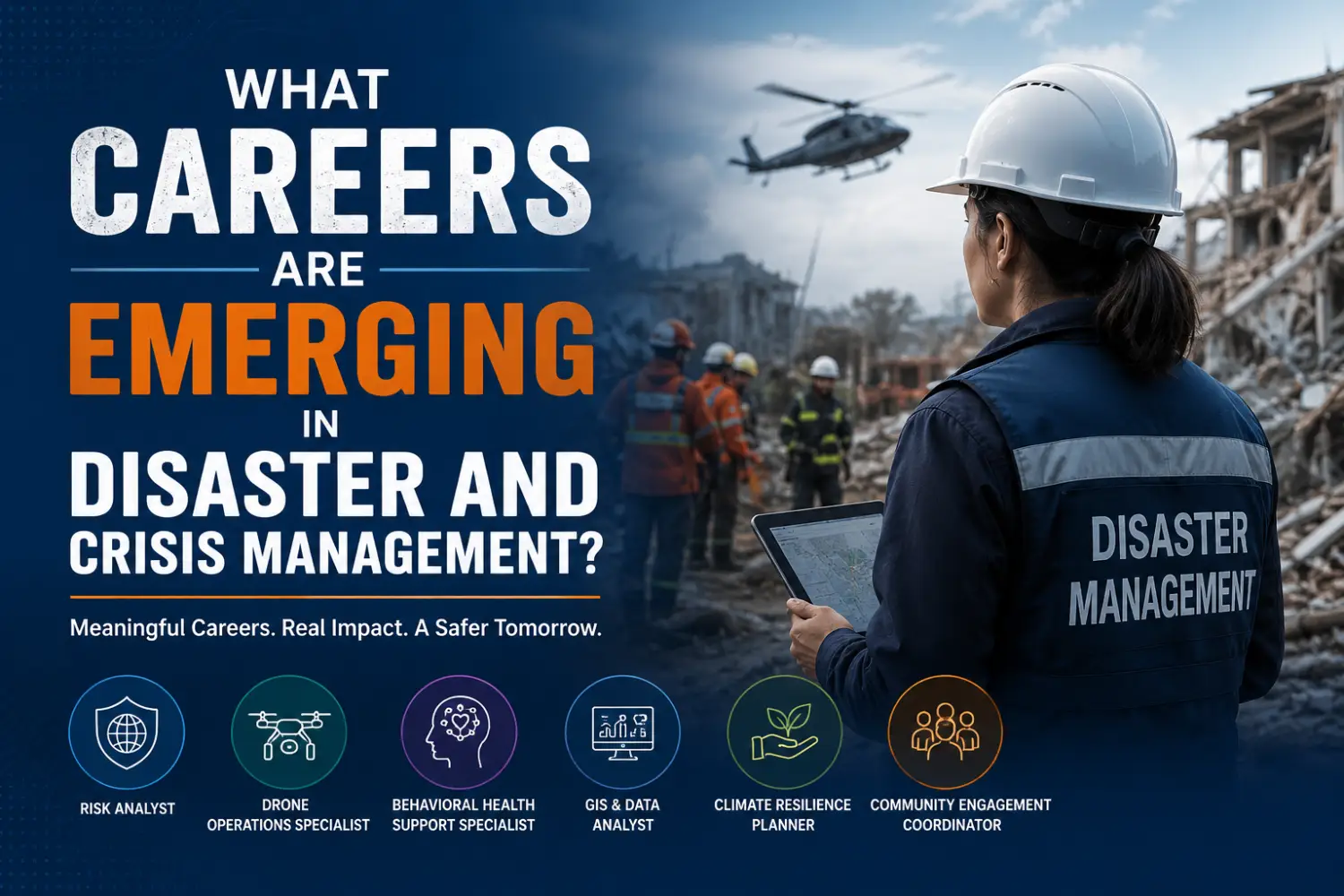
Disaster management specialists prepare governments or organizations for calamities and organize reactions when they arise. During a live crisis, the teams on the ground are led by the emergency response coordinator. A risk analyst looks at possible dangers, be they weather, infrastructure, or human, and helps businesses get ready for them.
And then there are new roles that are exploding. Climate change analysts try to understand how changing weather patterns are producing new threats. Environmental safety officers ensure workplaces and communities are up to safety requirements before something goes wrong. Crisis communication professionals help companies communicate correct information to the public in an emergency, and this is more important than most people know.
These avenues are attracting students from the B.Sc private colleges in Delhi in large numbers as they offer a solid job option with meaningful work. That combination is tougher to come by than it should be.
How Is Technology Changing This Field?
Here’s something that surprises many people when they first really delve into disaster management.
It’s really a technological field now.
Satellite monitoring can now see a storm growing over the ocean days before it hits land. AI systems can analyze data from thousands of sensors and forecast where flooding is most likely to happen. GIS mapping enables teams to visualize disaster zones in real time and coordinate rescue efforts more accurately than ever before.
Nowadays, drones are employed to explore locations that are too dangerous for rescue crews to reach on foot. Early warning systems can issue warnings to entire populations within minutes. Governments can use data analysis to determine where to deploy resources even before a calamity happens.
“That’s a field where those skills have huge real-world consequences for a student who loves technology and science.” You aren’t merely crunching numbers on a data sheet. You use data to tell you where to send rescue teams, which places to evacuate first, and how to distribute supplies.
The students of B.Sc private colleges in Delhi who are skilled in these technologies are entering the job market with a real edge. The need for people who understand the human element of disaster response and the technical tools that support it is exploding.
What Skills Do You Actually Need?
That’s a good question. And the honest response is that this is a field that needs people who can sustain two very different kinds of strength at the same time.
On the one hand, you need technical ability. Introduction to Risk Analysis: Experience with mapping and surveillance tools. Ability to read facts and make valuable judgments from them. Knowledge of safety standards and procedures of the government.
On the other hand, you need to be good with people. “Disasters don’t happen in a controlled environment. They happen to real people, scared and fatigued and sad. You don’t learn how to communicate properly under pressure, lead a team when things are chaotic, and make fast judgments when the stakes are high from a textbook alone.
That is why experience means so much in this sector. Students at B.Sc private colleges in Delhi who go through field training, real-world simulations, and project-based learning come out with something no exam result can really represent. They know how they perform when things are genuinely difficult.
Why Does the World Need More People in This Field Right Now?
The real answer is that calamities are happening more often.
Climate change is causing extreme weather events to happen more often and with greater intensity. More people are living in cities, which implies more people are concentrated in locations that confront unique risks. Conflicts in different parts of the world produce humanitarian catastrophes that demand coordinated international solutions.
Industries and governments are coming under growing pressure to develop official emergency preparedness strategies. That creates a need for qualified individuals not just in NGOs and government organizations but also in private companies, hospitals, construction firms, and international corporations.
The folks who labor in this sector save lives. That sounds simple, yet it is worth sitting with for a moment. The work you do directly influences how many people survive a flood, how quickly a city recovers from an earthquake, and how well a factory handles a toxic leak. Few occupations give that kind of direct influence.
Many students from B.Sc private colleges in Delhi chose this path exactly because of that. They desire a career that gives them financial stability and a sense that their work actually matters to the world around them.
How Can the Right College Prepare You for This Career?
Choosing where to study for a profession in disaster and crisis management is vital. This is not a field where you want to come out merely understanding theory.
You need a program that puts you in genuine scenarios. That trains you to use the tools pros actually use. That connects you with others currently working in the field. That requires you to think imaginatively and make decisions under pressure.
SRM University, Delhi NCR, Sonepat, is built around just this style of education. Students do not merely attend lectures. They work on research projects, engage with new tools and technology, and interact with industry specialists who bring real field expertise into the learning environment.
The university aggressively encourages students to explore beyond traditional answers and build problem-solving skills that work in unpredictable, high-stakes circumstances. That kind of training does not merely prepare you for your first job. It prepares you for every challenging occasion your career will eventually ask you to tackle.
For those researching B.Sc private colleges in Delhi, SRM University, Delhi NCR, Sonepat, is worth looking at seriously. It gives a strong academic basis alongside the practical exposure that this field actually demands.
What Does Choosing This Path Really Mean?
It means picking a vocation where no two days are the same.
It is knowing that the abilities you’ve learned and the knowledge you carry can save lives when it matters most. It means being the one in the room who knows what to do. It means being part of something larger than a job title.
The world is no longer predictable. The risks are rising. The need for qualified, intelligent, technically proficient professionals in disaster and crisis management will only increase.
And those students of B.Sc private colleges in Delhi who begin working towards that now are the ones who will be ready when it counts the most.
With the correct knowledge and the right mindset, that could easily be you.

