
Introduction
The countdown begins.
Ten. Nine. Eight.
The ground begins to shake. A rocket rises into the sky. Flames light up the sky. Somewhere in the crowd, a student watches in awe. Their heart races as they watch in amazement. Mouth agape. A thought slowly forms in their mind.
What if I could help build something like that?
That single thought can change a person’s life.
It transformed the life of the ISRO engineers who designed Chandrayaan. It impacted the career trajectory of the DRDO scientists who developed missile systems. And it is silently reshaping the destiny of students in schools all around India today.
This is not just a dream reserved for the lucky ones. It is a real and achievable career path. And it is growing rapidly. And it all begins with one decision: pursuing a B.Tech mechanical engineering in colleges in India.
Which Engineering Fields Are the Most Exciting Today?
Imagine two different engineering worlds.
In the first world, engineers design jets that whisk hundreds of people across continents at 900 miles per hour. They determine how much stress a wing can withstand. They test engines in wind tunnels. They ensure everything functions safely at 35,000 feet.
In the second world, engineers work on space technology. They manufacture satellites that orbit the Earth. They build systems that talk to each other across thousands of kilometres of space.
At the centre of both industries is the same kind of specialist.
A mechanical engineer.
Aerospace and defence are more than just industries. They represent the boundaries of technological innovation. They are where the toughest engineering challenges live. Where the margin for mistake is practically zero. In these fields, engineering designs must perform flawlessly under demanding conditions.
This is the very challenge that draws so many students to choose B.Tech mechanical engineering in colleges in India. Students choose this field not only for career growth or prestige but also for the opportunity to contribute to meaningful technological advancements.
What Careers Await After Engineering?
Let us look at some specific career opportunities.
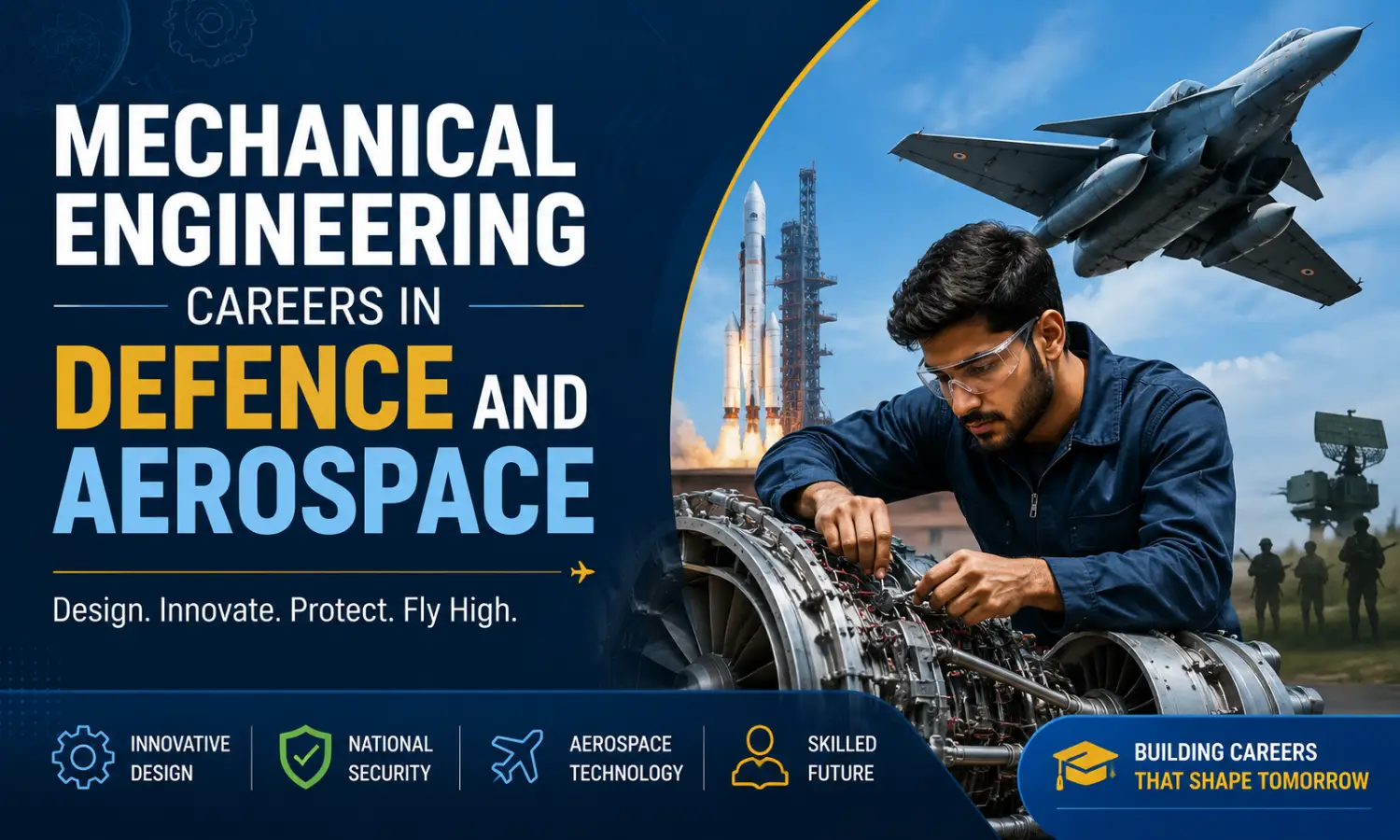
After completing a B.Tech mechanical engineering in colleges in India, graduates can take up jobs such as design engineer, aerospace engineer, manufacturing engineer, maintenance engineer, or research scientist.
Major recruiters include ISRO, DRDO, HAL, and BrahMos Aerospace. Tata Advanced Systems Ltd., Mahindra Defence Boeing India. Airbus in India. Airlines and MRO companies around the world.
These organisations require engineers who understand design, manufacturing, testing, and system performance.
For example, a design engineer at HAL could spend years honing a component of the Tejas fighter jet. A research scientist at DRDO might work on materials that can resist temperatures that no regular metal can. A production engineer at an aircraft company can be managing the production of a system where every bolt, every weld, every rivet has to be to exact specs.
These roles are far more than ordinary jobs; they contribute to national innovation and technological progress.
Why Is Mechanical Engineering Considered the Backbone of Industry?
Many people assume aerospace depends only on software or electronics.
However, behind every aeroplane, missile, rocket, and satellite, there is a framework. These systems must handle heat, pressure, stress, and structural loads. Understanding these conditions is a core responsibility of mechanical engineers.
B.Tech mechanical engineering in colleges in India teach these concepts from the fundamentals. Thermodynamics helps engineers understand how energy moves through engines and systems. Fluid mechanics explains how air flows over aircraft wings and other surfaces. Material science tells you which alloys can withstand severe temperature and stress. The design of machines includes the interaction of the components while the machine is loaded in real-world conditions.
These are not merely theoretical concepts. They are the difference between a jet that can fly and one that won’t.
The classroom provides the foundation of learning. Laboratories help students apply and test their knowledge. Eventually, students apply these skills in manufacturing plants, testing facilities, and launch sites.
Why Is India Investing Heavily in Engineering and Technology?
Technical knowledge is essential, but it alone is not enough.
The engineers who excel in aerospace and defence are accurate. Successful engineers must be precise and detail-oriented. They ask questions about everything. They check their work. They carefully review their work multiple times.
Students learning B.Tech mechanical engineering in colleges in India learn the abilities of CAD design and simulation tools. They learn to simulate complex systems before any individual component is made. They look into innovative materials, like composites and smart alloys, used instead of traditional metals in modern aeroplanes.
They are also learning more about robotics and automation. The future of aircraft production is not simply about human hands. The future of manufacturing depends on collaboration between people and machines. The engineers who understand both will lead.
Attention to detail is not just a soft skill in this industry. It’s a survival skill. A lost decimal point in aerospace is not a typo. Even a small error can lead to major consequences.
Which Skills Can Open Doors in Engineering Careers?
This is what makes this career path especially exciting today.
India is moving forward rapidly in these sectors.
India’s administration has promised huge investment in space exploration, domestic military manufacture, and advanced aerospace research. Indian astronauts are getting ready to go into space as part of the Gaganyaan mission. Make in India is promoting local manufacture of aeroplanes, drones, and defence systems. Private aerospace companies are also expanding quickly.
Students pursuing B.Tech Mechanical Engineering in colleges in India would not find this field to be saturated today. This field is currently entering a major growth phase.
The engineers graduating in the next 5 years will be stepping into an industry that is growing at the fastest pace in the history of India. The demand for skilled engineers is genuine and increasing. The positions are growing. The opportunities are worldwide.
How Does the Right Foundation Shape Future Success?
It all starts with where you study.
The best mechanical engineers were not the ones who remembered the most formulas. They are the ones who know how to apply their knowledge effectively. They actively worked in laboratories and practical environments. They learned how to solve real engineering problems. They were prepared to contribute from the very beginning of their careers.
SRM University Delhi-NCR, Sonepat (SRMUH) understands these industry expectations. The B.Tech admission process at SRMUH opens the door to sophisticated labs, practical training, and industry exposure that prepare students for these very high-pressure conditions.
SRMUH is considered one of the strong options for B.Tech Mechanical Engineering in colleges in India. The curriculum links theory and practice. Students develop the technical depth and professional intuition that aerospace and defence businesses want.
Securing admission to the B.Tech program at SRMUH is only the beginning. What follows is an education designed to produce engineers who are ready for the real world.
Are You Ready to Step Onto the Launchpad for Your Career?
Now return to that rocket launch.
The rocket is still rising into the sky. The audience still watches. And that student is still standing there with that powerful thought still running through their mind.
The choice lies between simply watching innovation and helping create it.
It begins with one degree and one important decision. A path into mechanical engineering can lead, for those prepared to work hard, directly into the most exciting sectors on earth.
The opportunity is waiting.

