
Introduction
Think about the last time a product you wanted was out of stock.
Maybe it was a phone, a car part, a piece of furniture, or even something as simple as a cooking ingredient. You probably shrugged and moved on. But somewhere behind that empty shelf or delayed delivery was a chain of events stretching across multiple countries, involving dozens of companies, thousands of workers, and hundreds of transport decisions that all had to go right for the product to reach you.
That is what a global supply chain is. And when conflict enters the picture anywhere along that chain, the effects travel fast and far.
For students exploring the best colleges for BBA and MBA in India, understanding how supply chains work and how conflicts disrupt them is not just an academic topic. It is one of the most practically important things you can learn about how business actually operates in a connected world.
What Is a Global Supply Chain and Why Does It Matter?
A global supply chain is a network. It connects raw material suppliers, manufacturers, shipping companies, warehouses, distributors, and retailers across multiple countries into a single system that moves goods from where they are made to where they are needed.
The scale of this is hard to fully picture. A car built in one country might contain steel from another, electronics from a third, rubber from a fourth, and software developed in a fifth. A smartphone sitting in your pocket likely has components that touched four or five continents before it reached the shop where you bought it.
This level of interconnection exists because it is efficient. Manufacturing in lower-cost locations, sourcing materials where they are most abundant, and moving goods through the cheapest available routes all reduce costs and make products more affordable for consumers.
But efficiency has a trade-off. The more stretched and interconnected a supply chain is, the more points of vulnerability it contains. And when conflict disrupts one of those points, the effects ripple outward across every other part of the chain.
Students at the best colleges for BBA and MBA in India study global supply chain management as a core part of their business education. Because the ability to understand, design, and manage these systems is one of the most valuable skills in modern business.
What Happens to Transportation and Logistics During a Conflict?
Transportation is almost always the first thing to feel the impact when conflict breaks out.
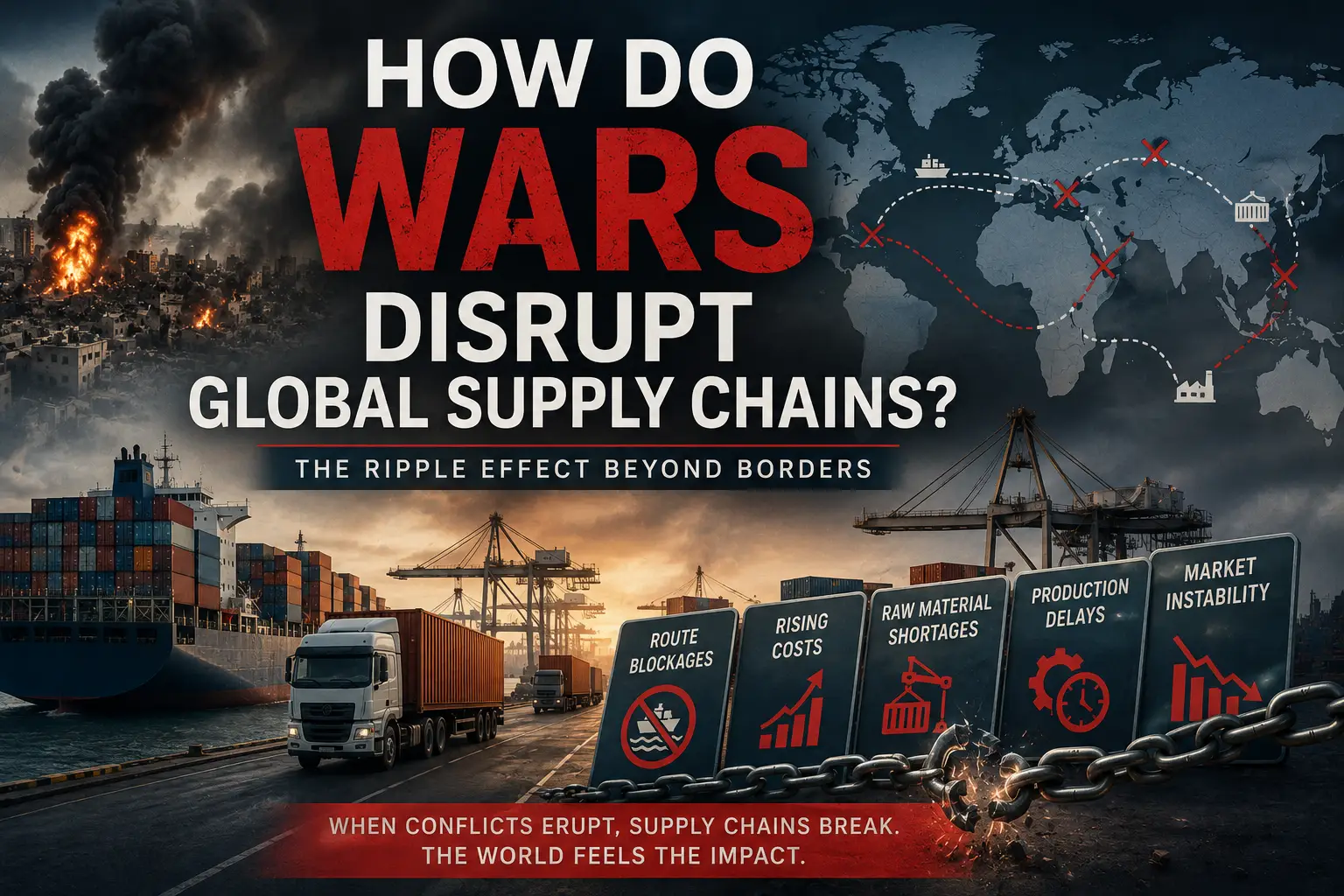
Shipping routes that run through or near conflict zones become dangerous. Ships divert to longer routes to avoid the risk, which adds days or weeks to delivery times and increases fuel costs significantly. Ports in affected regions may close entirely or operate at reduced capacity. Airlines suspend routes. Overland freight stops moving through borders that have become difficult or impossible to cross.
The Red Sea is a recent example that many people in business have been watching closely. When attacks on commercial shipping in that region increased, cargo ships began diverting around the southern tip of Africa rather than passing through the Suez Canal. That rerouting added significant time and cost to journeys between Asia and Europe. Prices rose. Delivery schedules slipped. Businesses that had planned around tight just-in-time delivery windows suddenly found themselves with gaps in their supply.
For businesses that depend on precise timing, these disruptions are not just inconvenient. They are expensive. Warehouses fill up waiting for delayed goods. Customers cancel orders. Production lines stop because components have not arrived.
Students at the best colleges for BBA and MBA in India learn about these logistics vulnerabilities because managing them is a central challenge for any business operating across borders.
How Do Conflicts Affect Manufacturing and Production?
The disruption does not stop at transportation. It works its way back through the supply chain into manufacturing and production as well.
Conflict in regions that produce raw materials creates immediate shortages for manufacturers that depend on them. If a country that supplies a key metal, chemical, or agricultural product is caught in conflict, companies that need that input have to find it elsewhere, often quickly, often at higher cost, and sometimes not at all in the short term.
Factories located in or near conflict zones face their own set of problems. Safety concerns mean workers do not show up. Infrastructure damage cuts off power or water. Local logistics break down, making it impossible to receive inputs or ship finished goods. In severe cases, factories simply shut down until the situation stabilises.
The semiconductor shortage that affected the global automotive and electronics industries a few years ago showed how a disruption to manufacturing capacity in a concentrated region can cascade across entire industries in ways that take years to fully resolve. Conflict adds another layer of unpredictability on top of the kind of disruptions that industries were already struggling to manage.
Labour is affected too. When workers are displaced by conflict or when people cannot safely travel to work, production capacity drops. Rebuilding that capacity after conflict ends takes time and investment.
These are the operational realities that business leaders have to navigate. The best colleges for BBA and MBA in India help students understand these challenges not as abstract risks but as practical problems that require concrete solutions.
What Does All of This Mean for Businesses and Consumers?
The effects of supply chain disruption do not stay inside companies. They flow through to customers and to society more broadly.
For businesses, the immediate impact is financial. When suppliers cannot deliver, companies have to find alternatives at short notice, which usually means paying more. When production slows, revenues fall while fixed costs remain. When delivery timelines stretch, customer relationships are strained. Managing a supply chain disruption while keeping the business financially stable is one of the hardest things a management team can face.
For consumers, the impact shows up as empty shelves, longer wait times, and higher prices. When essential goods become difficult to access, the consequences go beyond inconvenience. Medical supplies, food, fuel, and other necessities carry real human stakes when their supply chains break down.
The COVID-19 pandemic gave most people their first vivid experience of what large-scale supply chain disruption feels like from the consumer side. Shortages of goods that had always seemed reliably available made the invisible infrastructure of global supply chains suddenly visible. Conflicts can produce the same effects, sometimes more suddenly and in more targeted ways.
Students from the best colleges for BBA and MBA in India analyse how businesses manage these situations, how they communicate with customers during disruptions, and how they make decisions under pressure. That analysis builds the kind of judgment that is genuinely valuable in a management career.
How Do Smart Businesses Respond to Supply Chain Disruptions?
The businesses that come through supply chain disruptions best are not usually the ones that got lucky. They are the ones who had thought carefully about risk before the disruption arrived.
Diversification of suppliers is one of the most fundamental strategies. A company that depends entirely on a single supplier in a single country is completely exposed if that supplier or that country is affected by conflict. A company that has relationships with multiple suppliers across different geographies has options. It can shift volume from a disrupted source to a stable one without everything stopping.
Nearshoring and reshoring are strategies that have gained significant attention in recent years. Rather than chasing the lowest possible cost by manufacturing in distant locations, some companies have been moving production closer to their main markets. This reduces the length of the supply chain, which reduces the number of things that can go wrong, even if it increases the cost of production.
Technology plays an increasingly important role. Supply chain visibility tools allow companies to track where goods are at every stage of the journey in real time. That visibility means problems are spotted earlier, giving management more time to respond before a disruption becomes a crisis. Predictive analytics can flag potential risks based on geopolitical developments, weather patterns, and other signals before they affect operations.
Strong supplier relationships matter enormously, too. Companies that have invested in genuine partnerships with their suppliers, rather than treating them as interchangeable cost centres, find that those partners go further to help them through difficult periods.
The best colleges for BBA and MBA in India teach these strategies through real case studies of companies that have navigated supply chain crises. Because the lessons are much more meaningful when you can see exactly what worked and what did not in a real situation.
How Can SRM University, Delhi NCR, Sonepat, Prepare You for a Career in This Field?
If supply chain management, international business, or strategic management interests you, the quality of your education matters a great deal.
This is a field that rewards people who can think analytically about complex systems, make decisions under uncertainty, and communicate clearly with teams and partners across different cultures and time zones. Those skills are built over time through a combination of strong academic foundations and genuine practical exposure.
SRM University, Delhi NCR, Sonepat, builds its BBA and MBA programmes around exactly this combination. Students engage with global business strategy, supply chain management, and operational planning as substantive areas of study, not just theoretical concepts. The learning environment includes real case studies, industry interactions, and faculty who bring genuine management experience into the classroom.
For students looking at the best colleges for BBA and MBA in India, SRM University, Delhi NCR, Sonepat, offers a programme that takes the gap between academic learning and professional readiness seriously, and actively works to close it.
Why Does Understanding Supply Chains Matter for Your Future Career?
The disruptions of recent years, from the pandemic to geopolitical tensions to climate events affecting logistics, have made supply chain resilience one of the top priorities for business leaders around the world.
Companies are actively looking for people who understand how global supply chains work, what makes them vulnerable, and how to build systems that can absorb disruption without falling apart. That is a genuine and growing need, and people with the right knowledge and skills are in real demand.
The management students who come out of their programmes understanding not just the theory but the practical reality of how global supply chains operate in difficult conditions are the ones who will be most valuable to employers.
And that understanding starts with the right education.

