
Introduction
The machines were simple. Another gear turned the gear. A piston moved back and forth. You could read it and understand it. That world is lost. Machines think, detect, and respond now. They speak to software. They straighten up. And the engineers who construct them need a different sort of mentality.
This is why mechanical engineering courses in India are evolving. The previous syllabus is not enough anymore. Students need to learn how to code, how to work with sensors, how to construct logic. It is not just metal and motion. Here’s a look at why this change is happening and what it means for students choosing a path.
What Makes Mechanical Engineering Feel Different Today?
Mechanical engineers used to deal with physical systems. Materials strength. Thermodynamique. Fluid dynamics. These problems still count. But they are not the complete story anymore.
- Today, factories are run by sophisticated systems. Cars are built by robots. Sensors detect degradation before a component fails.
- If a student from mechanical engineering courses in India has only expertise in mechanics, it will be difficult to work in this new environment. That is why mechanical engineering schools in India increasingly integrate machinery with electronics and computing. The subject has acquired a new skin, and students need to grow with it.
Why Are Mechatronics Skills Reshaping Mechanical Engineering Courses in India?
Mechatronics is a basic concept. It is a combination of mechanics, electronics, and software. A nice example is a robotic arm. It has motors, but it also has sensors and a brain instructing it what to do.
The mechanical engineering courses in India are finding that this is what industry wants. A student who knows both hardware and control systems is a lot more valuable on a production floor. This is one of the major reasons to include Mechatronics as a core subject in Mechanical Engineering curricula in India and not as an elective hidden away in the last year.
Some of the abilities pupils are currently learning early include:
- Microcontrollers and programming basics
- Sensors and actuators integration
- Logic, robotics & Automation
- PLC and control systems
They aren’t even talents anymore. They are being folded into the main degree.
How Does Design Thinking Change the Way Students Learn?
Design thinking is not about making nice pictures. It’s a method. You begin with knowing an actual problem. You question who has to face it and why. Then you develop, test, and improve, again and again.
This is an upside-down take on engineering education. The students would memorize formulas and work out set problems. Now students must solve open questions with no right answer. It’s a big move because mechanical engineering courses in India are meant to prepare students for real-life work environments, not just tests. The design thinking mindset is tolerance, empathy, and the guts to fail and try again.
What Does a Modern Mechanical Engineering Curriculum Look Like?
A student walks into a lab, imagine. On the table is a three-dimensional printer. Another shows a little robot awaiting programming. Nearby, a group talks about how to adapt a wheelchair to be more comfortable. This isn’t a computer science lesson. This is mechanical engineering, 2026.
A modern curriculum is a mixture of several worlds. These days, good mechanical engineering degrees in India include
- Laboratories of Robotics and Automation
- Training in CAD and simulation software
- Design assignments for all fields
- Work-integrated learning
- AI and data-driven maintenance experience
It’s easy. Students from mechanical engineering courses in India should leave college ready to build objects that think, not merely move.
| Skills That Give Mechanical Engineering Students a Competitive Edge | ||
|---|---|---|
| Skill | Why It Matters | Career Benefit |
| CAD Software (SolidWorks, CATIA, AutoCAD) | Enables efficient product design and modeling | Better opportunities in design engineering |
| Robotics & Automation | Supports automated manufacturing systems | High demand in Industry 4.0 sectors |
| Programming (Python/C/C++) | Helps develop and control intelligent systems | Expands opportunities in automation and robotics |
| PLC & Industrial Automation | Essential for factory automation | Preferred by manufacturing companies |
| AI & Predictive Maintenance | Improves equipment reliability using data | Opens roles in smart manufacturing |
| Design Thinking | Encourages innovative, user-centric problem-solving | Valuable in product development and R&D |
| Communication & Teamwork | Essential for cross-functional collaboration | Improves employability and leadership potential |
| Internship & Industry Projects | Provides practical experience before graduation | Increases chances of campus placements and higher salary offers |
Why Do Employers Want Engineers Who Can Do Both?
Let’s take an example of an electric vehicle manufacturing company. They don’t want a guy who can just fix engines. They need someone who understands all battery systems, sensors, and mechanical design together. No single ability is sufficient.
That is today’s silent hiring trend. Corporations want graduates who can easily switch specialties. Hence, the mechanical engineering courses in India are getting restructured around mechatronics and design thinking. This form of learning doesn’t just get people jobs. They get to make the future, one working prototype at a time.
| Job Role | Industries Hiring | Average Annual Salary in India |
|---|---|---|
| Mechanical Design Engineer | Manufacturing, Automotive, Aerospace | ₹4–8 LPA |
| Robotics Engineer | Robotics, Automation, AI | ₹6–12 LPA |
| Automation Engineer | Manufacturing, Industrial Automation | ₹5–10 LPA |
| Mechatronics Engineer | Automotive, Electronics, Smart Manufacturing | ₹5–11 LPA |
| PLC & Control Systems Engineer | Process Industries, Oil & Gas | ₹4.5–9 LPA |
| Product Development Engineer | Consumer Products, Automotive | ₹5–10 LPA |
| Maintenance Engineer (Industry 4.0) | Manufacturing, Heavy Engineering | ₹4–8 LPA |
| IoT Systems Engineer | Smart Devices, Industrial IoT | ₹6–12 LPA |
Salary ranges are approximate and vary based on skills, company, location, and experience.
Where Does SRMUH Fit Into This Story?
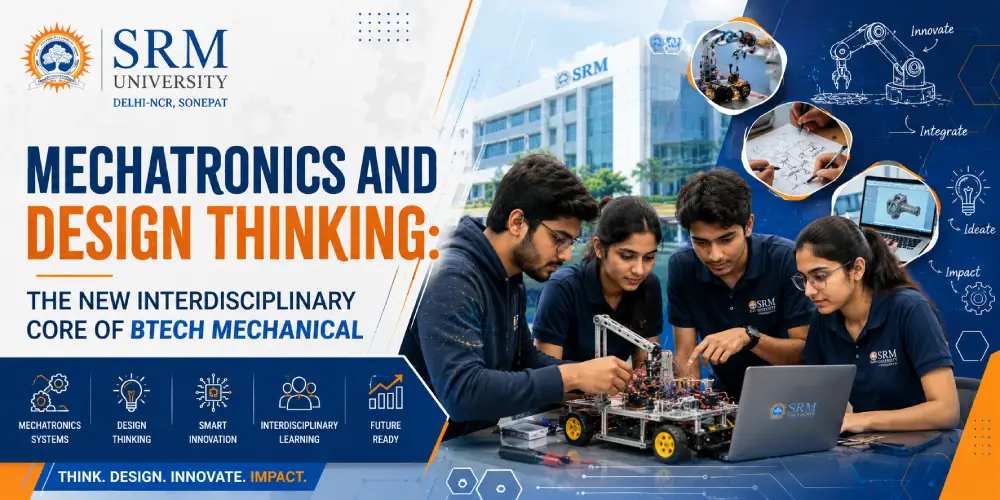
This transition is already underway somewhere on the forty-eight-acre green campus at Sonepat, Haryana. This very thinking has developed SRM University, Delhi-NCR, Sonepat, Haryana, SRMUH, Faculty of Engineering & Technology.
- SRMUH’s Department of Mechanical Engineering runs B.Tech in Robotics & Automation as well as the regular B.Tech in Mechanical Engineering. That’s not a coincidence. It’s a reflection of the same mechatronics and design thinking approach we have been talking about.
- Students learn ancient formulas, not only. They join real industry partners in Centres of Excellence such as the ACMA CoE, SRM-BOSCH CoE and SRM-Siemens CoE.
- And the teaching team brings this to life. The department is headed by Associate Professor Dr. R. Sankar, with faculty members Dr. Ashok Kumar Mishra and Dr. SVSK Deepak Kumar, along with a team of assistant professors who guide students through experiential learning.
- Also, SRMUH is in a university created for this purpose, for this interdisciplinarity. The campus has more than seventy programmes and more than fifty connections with industry, which help students of mechanical engineering to explore beyond the discipline.
- The college is rated AAAA+ by Careers360 in North India. A student can walk from a robotics lab to a design studio in minutes, and that proximity informs the way they think.
This is how the next generation of mechanical engineering courses in India should be. Not only machines. Not only code. The real blend of both is taught by professionals who know where the business is going.
FAQ’s
1. What is mechatronics and why is it relevant for B.Tech Mechanical students?
Mechatronics is the combination of mechanical engineering, electronics, control engineering, and computer science to form intelligent and automated systems. It provides the interdisciplinary skill set demanded by modern industry to the students of mechanical engineering.
2. What role might Design Thinking play for mechanical engineering students?
Design Thinking is user-centered, creative, and involves prototyping and iterative testing of solutions. It allows students to produce unique, practical, and market-ready engineering solutions.
3. What professional prospects are available with mechatronics and Design Thinking skills?
Graduates can explore job opportunities in robotics, automation, automotive engineering, manufacturing, aerospace, product design, IoT, and smart systems in Industry 4.0-adopting industries.
4. Why are mechatronics and Design Thinking the new heart of mechanical engineering?
Engineers nowadays need to be able to mix mechanical know-how with electronics, software, and design driven by innovation to address the engineering issues of today. Together, mechatronics and Design Thinking prepare students to design intelligent products and address challenging real-world challenges effectively.

