
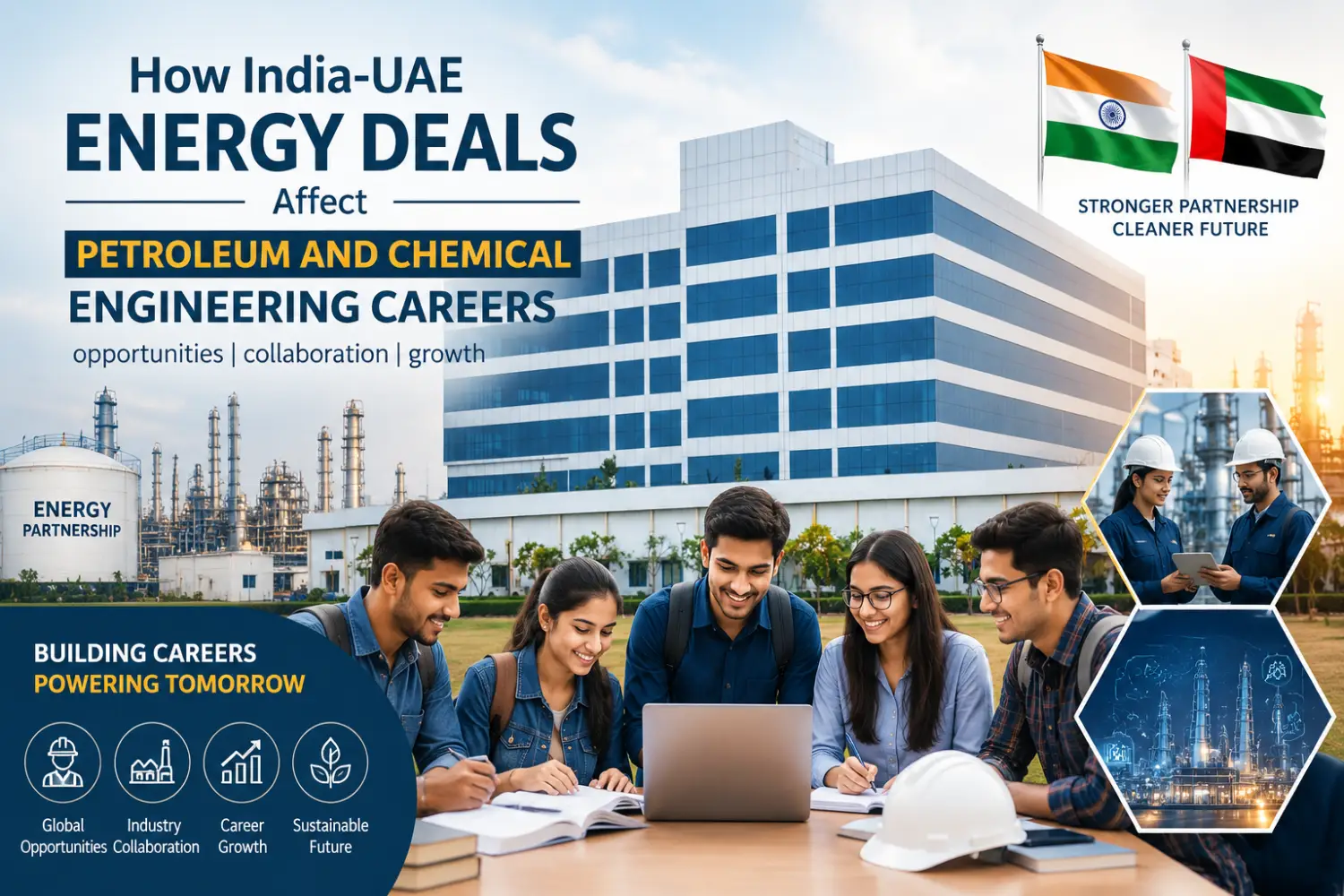
Introduction
It began with a handshake.
It did not happen inside a classroom or a laboratory.
It happened in a boardroom between two nations.
India and the UAE signed a multi-billion-dollar agreement covering oil pipelines, refinery partnerships, chemical processing, and clean energy collaboration.
Meanwhile, far away from those boardrooms, a student opened a laptop and searched for private colleges in Delhi for BTech.
The students may not have realised it all the time. However, those two events were closely connected.
What Exactly Did India And UAE Agree To?
The agreements cover a wide range of sectors.
The UAE is a major source of India’s crude oil imports. Those two countries have been cementing that supply link for years. But the newer deals go further. These include collaborative ventures to upgrade refineries. The agreements also include partnerships in petrochemical production. LNG infrastructure investments and an increasing focus on green hydrogen and the clean energy transition.
India’s energy demand continues to grow rapidly. The country needs additional refineries and processing facilities. More engineers who know how to turn crude oil into fuel, how to synthesise chemicals on an industrial scale, and how to construct energy systems to last for decades.
The UAE also requires skilled infrastructure and engineering support for its energy sector.
Now, both countries are creating the infrastructure to support these accords. And none of this infrastructure can be built without skilled engineers.
Why These Deals Generate Engineering Jobs at Private Colleges in Delhi for BTech?
This is where the connection to engineering education becomes important.
Petroleum engineers are essential for refinery expansion projects. Chemical engineers play a key role in every chemical processing facility. Every pipeline system needs experts who understand fluid dynamics, thermodynamics, and the behaviour of materials under severe pressure.
These opportunities are increasingly being created within India itself. India is actively developing its domestic industrial capacity. Reliance, ONGC, HPCL, BPCL, and a whole host of private businesses are all expanding. The India-UAE deals are speeding up that growth with foreign funding and technology transfer.
Students choosing private colleges in Delhi for B.Tech. in chemical or petroleum engineering are entering an employment market that is being actively altered by agreements like these. This demand is not just theoretical. The impact can already be seen in hiring trends, campus recruitment, and salary brackets being offered to fresh graduates is something we can already witness.
What is a Petroleum or Chemical Engineer Really Doing?
To understand this better, let us look at the specific roles involved.
Petroleum engineers plan the technologies used to get oil and gas out of the ground. They are studying the behaviour of reservoirs. They plan drilling operations and extraction methods. They make extraction effective, safe, and inexpensive. Their work focuses on upstream operations, which means getting the resource out of the earth, and more and more on midstream logistics, which means moving it from the field to the refinery.
After extraction, chemical engineers take over the refining and processing stages. They design the methods that turn raw crude into usable products. These products include petrol, diesel, aviation fuel, plastics, fertilisers, pharmaceuticals, and solvents. The range of products is extensive.
Both positions demand extensive knowledge of thermodynamics, fluid mechanics, reaction engineering, process design, and materials science. Both professions are in high demand and offer strong salary prospects. And currently, the impetus of India-UAE energy cooperation is pulling both up.
Students Also Read: AI Courses in Delhi
Which Industries Are Hiring graduates from Private Colleges in Delhi for B.Tech?
The hiring opportunities in this sector are extensive.
In the petroleum sector, they get jobs in ONGC, Oil India, Cairn Energy, Schlumberger, Halliburton, and Baker Hughes. The UAE is also an important employer in this sector, and ADNOC and its subsidiaries are on look-out for competent engineers from India.
In the chemical sector, firms such as Reliance Industries, BASF India, Tata Chemicals, GAIL, and Indian Oil draw extensively from engineering universities. The growing demand for speciality chemicals, agrochemicals, and green chemistry is opening up new verticals that didn’t exist ten years ago.
The India-UAE green energy partnership is also creating a new avenue of opportunities. In hydrogen generation, carbon capture, and renewable energy integration, chemical engineers with knowledge of both classic and innovative process technologies are needed.
Students who have done their BTech from private colleges in Delhi and have a good base are facing a market where demand is always more than supply.
What Skills Will Make You Stand Out in This Field?
Technical expertise is the most important requirement in this field. However, technical knowledge alone is not enough.
The industry has now become dependent on process simulation tools like Aspen Plus and HYSYS. Engineers familiar with CAD tools, HAZOP analysis, safety engineering, and project management skills are a lot more employable.
Knowledge of environmental rules and sustainability frameworks is equally crucial. The clean energy component of the recent deals between India and the UAE means that future engineers will need to operate across both fossil fuel systems and clean energy infrastructure. Versatility has become a major career advantage.
Communication skills and cross-cultural understanding are also highly valuable. Working on joint ventures between Indian and UAE companies entails collaborating across teams, time zones, and expectations. In such environments, engineers who can work well together are prized.
Students at private colleges in Delhi for BTech who pursue internships, live projects, and industry certifications during their degree are the ones who walk out with both a qualification and a portfolio.
Why SRM University Delhi-NCR, Sonepat, is the Right Place to Lay This Foundation?
The right college does more than simply teach engineering concepts. It prepares students for the realities of the professional world.
SRM University Delhi-NCR, Sonepat, recognises the needs of today’s energy sector. Here, the B.Tech. curriculam are based on practical learning. The university offers modern laboratories. Its academic programs are closely linked with industry requirements. Students also gain hands-on project experience. The curriculum includes practical exposure to tools and techniques used in the industry.
SRMUH gives students an environment where the curriculum is in line with industry trends. At SRMUH, students study these industry developments as part of current discussions and projects. These topics are already discussed in classrooms and project briefings.
For students who are eyeing private institutions in Delhi for B.Tech. in chemical or petroleum engineering, SRMUH provides a unique blend of academic rigour, practical training, and career support, which converts into the kind of readiness these firms are seeking. The Delhi-NCR location also brings students closer to a huge pool of recruiters, industry events, and internship opportunities.
So, what does the bigger picture look like?
When viewed from a broader perspective, a bilateral energy arrangement between two countries is more than a geopolitical headline. It signals future industrial and economic direction. It tells engineers where infrastructure will be developed, where investment will flow, and where careers will be moulded for the next two decades.
India’s industrial and energy growth is accelerating rapidly. Its energy needs will continue to grow. The country must continue scaling up its domestic production. The collaborations with the UAE are fast-tracking that growth with funding, technology, and shared goals.
Every refinery created needs engineers to design it. Every operational chemical plant needs engineers to operate it. And every new hydrogen facility creates a need for engineers who understand the chemistry and the systems.
The student searching for private colleges in Delhi for BTech may have made a small decision.
However, the opportunities created by these agreements are prepared to reward them in ways that they have not even begun to envisage.
These pipelines carry more than just oil.
They also carry opportunities for future engineers. Those opportunities ultimately reach the engineers ready to build and operate these systems.
Catch placement highlights, fests, and campus moments — follow SRM University on LinkedIn

