
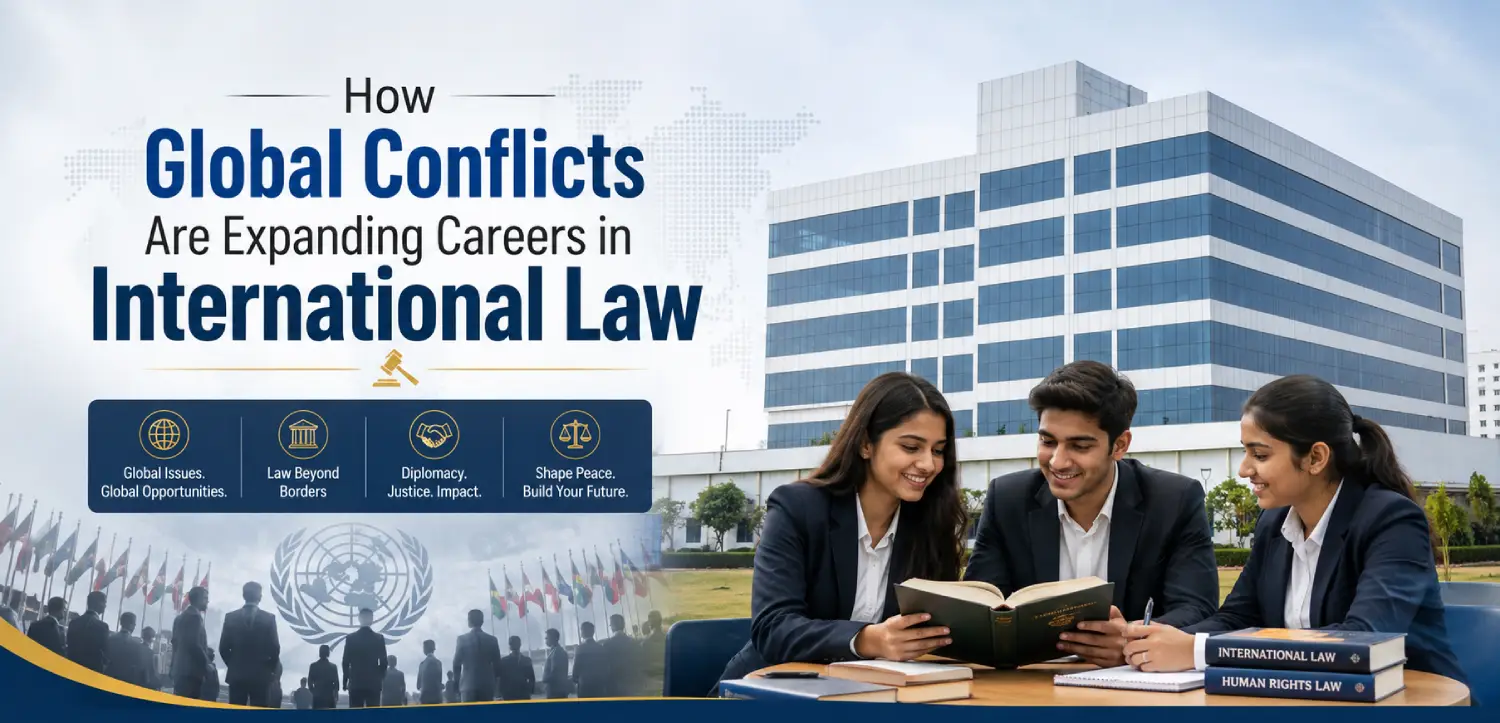
Introduction
Conflict rarely stays where it starts.
A war in Eastern Europe disrupts grain supplies across Africa. Sanctions imposed by Washington affect companies in Mumbai. A territorial dispute in the South China Sea is reshaping global shipping insurance law. A ceasefire negotiated in Geneva creates obligations that domestic courts in a dozen countries must interpret.
Modern conflict is legally complex in ways that previous generations of international lawyers did not have to navigate. And that complexity is creating a genuine and growing demand for lawyers who understand how international law operates when geopolitics becomes unstable.
For students looking at LLB colleges in Delhi NCR, this is worth understanding clearly. Because international law is no longer a niche academic specialisation, it is one of the most actively growing areas of legal practice. And the conflicts reshaping the world right now are a significant part of why.
Why Do Global Conflicts Create Legal Work?
The connection between conflict and legal careers is more direct than most students realise.
Here is how conflict generates legal demand:
- Sanctions compliance: When major powers impose economic sanctions, companies everywhere must ensure their transactions do not violate those restrictions. This creates substantial compliance legal work.
- War crimes documentation: International and domestic courts that prosecute war crimes and crimes against humanity need lawyers to document evidence, build cases, and represent parties.
- Refugee and asylum law: Armed conflict produces displacement. Immigration lawyers handling asylum claims from conflict zones are in consistently high demand.
- International arbitration: Investment disputes, contract frustration claims, and insurance disputes arising from conflict all fall within its purview.
- Humanitarian law: Organisations operating in conflict zones need legal guidance on international humanitarian law, specifically what is permissible under the laws of war.
- Treaty interpretation: Existing treaties often have ambiguous application when new conflicts create novel situations. Legal interpretation becomes essential.
- Reconstruction contracts: Post-conflict reconstruction involves billions in contracts, infrastructure financing, and development agreements requiring legal expertise.
Each of these areas is active right now. Ukraine, Gaza, Sudan, and multiple other ongoing conflicts are generating legal work across all of them simultaneously.
What Is International Law and How Does It Actually Work?
Understanding the structure of international law is fundamental for LLB students interested in this area.
International law is not a single unified legal system. It is a layered framework built from several sources:
- Treaties and conventions: Formal agreements between states that create binding obligations. The Geneva Conventions, UN Charter, Rome Statute, and bilateral investment treaties are all examples.
- Customary international law: Rules that have developed through consistent state practice over time and are binding on all states regardless of treaty ratification.
- General principles of law: Principles recognised across major legal systems that fill gaps in treaty and customary law.
- Judicial decisions and scholarly writings: Decisions of international courts and the work of international law scholars contribute to how the law develops.
Key institutions that apply and develop international law include:
- International Court of Justice (ICJ): The principal judicial organ of the UN. Resolves disputes between states.
- International Criminal Court (ICC): Prosecutes individuals for genocide, war crimes, and crimes against humanity.
- World Trade Organisation (WTO) dispute panels: Resolve trade disputes between member states.
- International arbitration tribunals: Handle investment and commercial disputes with cross-border dimensions.
- Human rights courts and commissions: The European Court of Human Rights, African Court on Human and Peoples’ Rights, and UN treaty bodies.
For LLB students at colleges in Delhi NCR, understanding this architecture is the starting point for any serious engagement with international legal practice.
How Specific Conflicts Are Creating Specific Legal Work
The Russia-Ukraine War
This conflict has generated more international legal work than any event since the Second World War.
Here is what that looks like in practice:
- ICC proceedings: The ICC issued arrest warrants for Russian officials. Prosecuting these cases requires international criminal lawyers across multiple jurisdictions.
- Asset freezes and sanctions: Russian state assets frozen in Western countries have generated enormous litigation over the legality of seizure and the rights of asset holders.
- Corporate withdrawal litigation: Companies that exited Russia faced contractual disputes, asset confiscation claims, and insurance litigation.
- Reparations framework: International discussions about using frozen Russian assets to fund Ukrainian reconstruction are creating novel legal questions about state liability and asset seizure.
- Refugee law: Millions of Ukrainians sought asylum across Europe, generating case volumes that strained refugee legal systems.
Also Read: Top Colleges for Law in Delhi
Middle East Conflicts
Ongoing conflicts in Gaza and the broader Middle East are generating significant international legal activity.
Key legal dimensions include:
- Genocide and war crimes proceedings: South Africa’s case against Israel at the ICJ brought unprecedented attention to the Genocide Convention and the obligations of third states.
- Sanctions and arms export law: Multiple countries are reviewing arms export licences to parties in the conflict, generating legal disputes about government compliance with their own arms control laws.
- Humanitarian access law: Disputes about whether humanitarian law obligations are being met involve legal teams from international organisations, NGOs, and state parties.
- Media and international humanitarian law: Questions about the legal status of journalists in conflict zones and obligations to protect media personnel are active legal issues.
Emerging Legal Frameworks
Beyond specific conflicts, several cross-cutting legal developments are creating new career opportunities:
- Cyber warfare law: No established international law framework fully governs state-sponsored cyber attacks. Lawyers are actively developing the arguments and precedents.
- Space law and conflict: Satellites have become military assets. The law governing attacks on or through space infrastructure is underdeveloped and actively contested.
- Climate conflict nexus: Resource conflicts driven by climate change are creating novel questions about when climate impacts give rise to state responsibility.
What Career Paths Does International Law Open?
The career landscape for LLB graduates interested in international law is genuinely broad.
Here are the main directions:
- Indian Foreign Service (IFS): The UPSC civil services pathway to a career representing India in international forums and negotiations. Strong international law knowledge is essential.
- International organisations: The UN and its agencies, WHO, WTO, UNHCR, UNICEF, and dozens of other bodies employ legal officers from across the world. LLB graduates who pursue additional international law qualifications are competitive candidates.
- International law firms: Global firms with offices in India handle cross-border transactions, international arbitration, and sanctions compliance. LLB graduates with strong foundations in international law enter these firms with genuine relevance.
- Government legal departments: The Ministry of External Affairs, the Ministry of Commerce, and the Ministry of Finance all employ lawyers working on international legal matters, including trade law, treaty negotiation, and sanctions compliance.
- Human rights organisations, such as Amnesty International, Human Rights Watch, and Indian organisations like the People’s Union for Civil Liberties, work on documentation and advocacy that require legal expertise.
- International arbitration practice: India is growing as a seat for international arbitration. Lawyers who understand investment treaty arbitration and cross-border commercial arbitration are in demand.
- NGOs in conflict zones: Legal advisors to humanitarian organisations operating in conflict areas need knowledge of international humanitarian law and refugee law.
- Academia and research: Think tanks and universities studying international law, conflict resolution, and global governance employ researchers with strong legal backgrounds.
What Skills Does International Law Practice Require?
Beyond the LLB foundation, international law practice demands specific capabilities.
Key skills include:
- Research and legal analysis: International law involves working across multiple legal systems, treaty frameworks, and jurisdictions. Deep research capability is essential.
- Writing and argumentation: International lawyers write briefs, memoranda, and submissions that must be precise, well-structured, and persuasive to audiences from different legal traditions.
- Language capability: English is the primary language of international legal practice. A second language relevant to international legal work, French, Spanish, Arabic, or Mandarin, is a significant asset.
- Cross-cultural competence: Working effectively across different legal systems and with clients and counterparts from diverse backgrounds requires genuine cultural awareness.
- Understanding of geopolitics: International law does not operate in a political vacuum. Lawyers who understand the geopolitical context of the legal questions they work on are more effective advisors.
- Treaty and document analysis: Reading, interpreting, and applying the provisions of complex multilateral treaties is a specific skill that develops with practice and study.
How Does an LLB Prepare Students for This Field?
A strong LLB programme lays the foundation for a career in international law. Here is what matters most:
- Constitutional and public law: Understanding how domestic legal systems interact with international obligations.
- Public international law: The foundational course covering treaty law, state responsibility, jurisdiction, and international institutions.
- International humanitarian law: The laws of armed conflict and the legal framework governing how wars must be conducted.
- International trade and investment law: WTO agreements, bilateral investment treaties, and the legal framework of international commerce.
- Human rights law: International human rights standards and the mechanisms available to enforce them.
- Moot court experience: International moot courts like the Philip C. Jessup International Law Moot Court Competition are the gold standard for developing the practical skills of international legal argument.
- Research opportunities: Working on international law research alongside faculty deepens the knowledge that distinguishes serious international lawyers.
Why Should You Consider SRM University Delhi-NCR, Sonepat?
Choosing the right LLB college in Delhi NCR shapes both the quality of the legal education and the professional opportunities available after graduation.
SRM University Delhi-NCR, Sonepat (SRMUH) approaches legal education with a clear focus on preparing students for the demands of contemporary legal practice. Here is what the programme offers:
- A curriculum that covers international law, human rights, and public law as substantive areas of study.
- Moot court experience that develops the practical advocacy and argumentation skills that international legal careers require.
- Research opportunities that allow students to engage with international law questions at a genuine depth.
- Internship support that connects students to legal practice in the Delhi NCR region, one of India’s most significant legal markets.
- Faculty who bring real expertise and current engagement with the field into the learning environment.
- Career guidance that helps students navigate the options available after graduation.
The university’s location in Delhi NCR is a genuine asset for students interested specifically in international law. The capital region is home to the Supreme Court, the Ministry of External Affairs, major law firms with international practices, international organisations with offices in India, and the diplomatic community that generates international legal work. Being part of that ecosystem during an LLB programme creates opportunities that are not available from more distant locations.
Among LLB colleges in Delhi NCR, SRMUH offers a programme that takes the ambitions of students interested in international legal careers seriously.
What Does Choosing International Law Actually Mean?
The conflicts reshaping the world right now are not going to resolve cleanly or quickly.
The legal questions they generate, about state responsibility, individual accountability, civilian protection, sanctions legality, displacement rights, and post-conflict reconstruction, will be worked through in courts, tribunals, and negotiating rooms for decades.
The lawyers who understand international law deeply enough to contribute to that work are doing something genuinely important. They are part of the infrastructure through which the international community holds power accountable, protects the vulnerable, and builds the frameworks that enable future cooperation.
That is serious and consequential work. It is also intellectually rich in a way that few legal practices match, sitting at the intersection of law, history, politics, and ethics simultaneously.
For students at LLB colleges in Delhi NCR who want their legal careers to matter at this scale, international law is a path worth serious consideration.
The world needs lawyers who understand it at this level.
FAQs
Q.1: How do global conflicts create jobs in international law?
Conflicts create new legal needs. This increases demand for international lawyers.
Q.2: Which areas are in demand?
Human rights, war crimes, sanctions, and refugee law are in demand.
Q.3: What jobs can students get?
Students can become lawyers, legal advisers, diplomats, or policy analysts.
Q.4: What skills are needed?
Good writing, research, and communication skills are important.
Q.5: Is international law a good career?
Yes. It offers many global career opportunities.

