
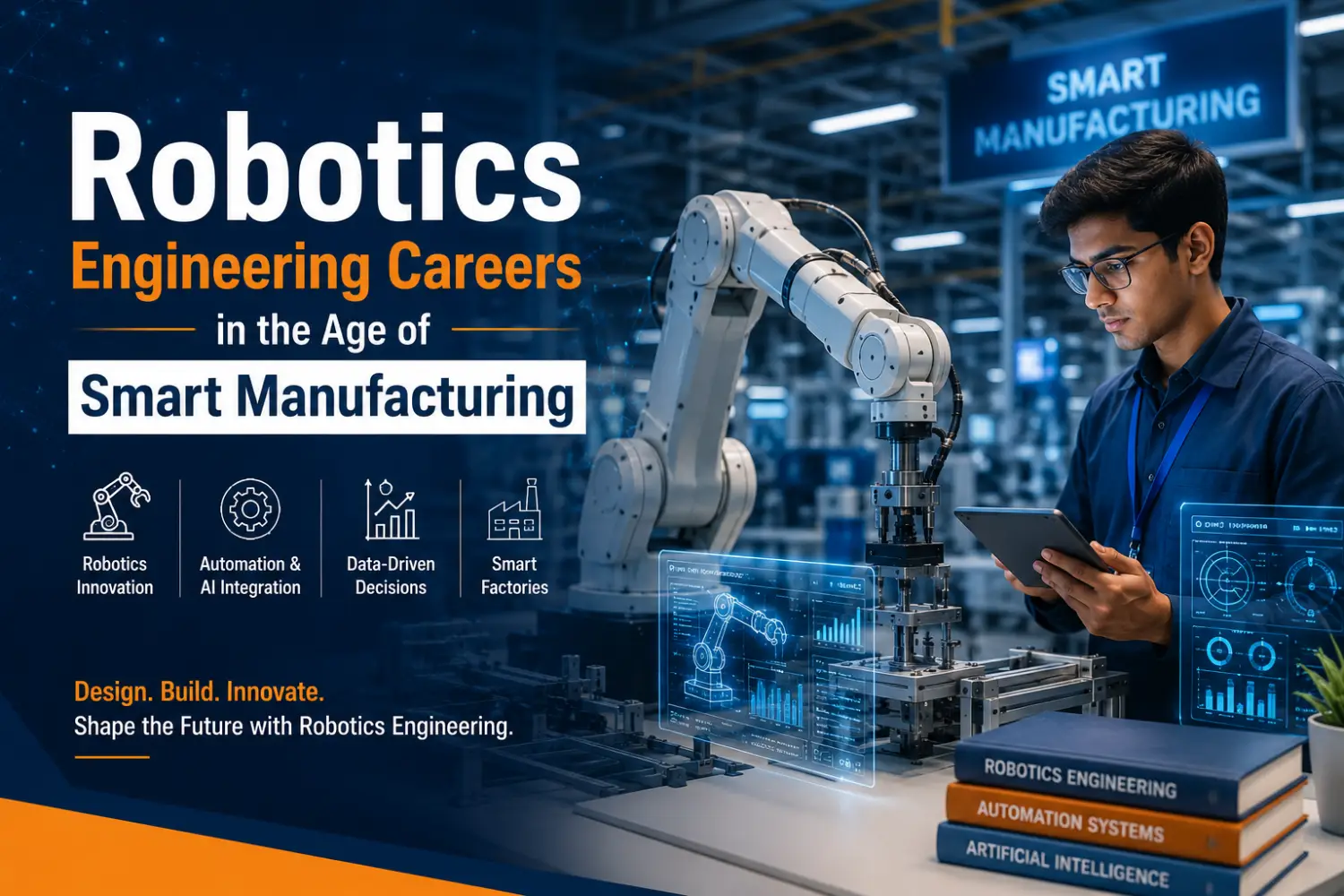
Summary: Robotics is changing manufacturing. Factories now use smart machines and automation. Robots handle repetitive work with speed and accuracy. Humans now focus on design, control, and problem-solving.
This creates careers like robotics engineer, PLC programmer, and automation engineer. These roles exist in many industries like automotive, healthcare, and logistics.
Engineers today need coding, electronics, and data skills. They also need problem-solving and adaptability. Colleges matter because hands-on training is essential. Institutions like SRM University Delhi-NCR, Sonepat help students gain real industry experience.
This field is growing fast. It offers strong and future-ready career opportunities.
Introduction
Walk into a modern factory today, and something feels different.
It is not as loud as factories used to be. It is precise. Machines move with a quiet confidence. A robotic arm picks up a component, positions it perfectly, and moves on to the next one without hesitation. Screens on the wall show live data about every part of the production line. A human engineer stands nearby, not operating the machine but monitoring the system, adjusting parameters, and solving problems that the system flags in real time.
This is what manufacturing looks like now. And it looks nothing like it did twenty years ago.
For students exploring robotics and automation engineering colleges in India, this shift is not something that will happen in the distant future. It is the environment they are preparing to step into. And the opportunities it is creating are genuinely exciting.
What Is Driving the Rise of Robotics in Manufacturing?
The short answer is that businesses need to do more, faster, with fewer errors.
Global competition is intense. Customers expect products to be delivered quickly and to work perfectly. Supply chains are complex. The margin for error is thin. Manual processes, however skilled the workers performing them, cannot match the speed, consistency, and precision that automated systems can deliver at scale.
Robotics addresses all of these pressures at once. An automated assembly line can run around the clock without fatigue. A robotic welding system produces the same quality of weld on the 10,000th unit as on the first. A vision-guided picking system in a warehouse can identify and retrieve items faster and more accurately than a human worker would do manually.
This does not mean humans are leaving manufacturing. It means the role that humans play is changing significantly. The focus is shifting from doing repetitive physical tasks to designing, programming, maintaining, and improving the automated systems that perform those tasks.
Students at robotics and automation engineering colleges in India are learning to operate at exactly that level, not as button-pushers, but as the engineers who build and run intelligent systems.
What Career Paths Open Up in This Field?
One of the things that surprises students when they look into robotics and automation seriously is how many different directions a career in this field can take.
PLC Programmers write and maintain the software logic that controls industrial machines and production lines. They are in demand across virtually every sector that uses automated equipment, which is most of them.
Robotics Engineers design and develop robotic systems, from the mechanical structure to the software that drives it. This role requires a combination of mechanical engineering knowledge, electronics understanding, and programming skills.
Control Systems Engineers work on the feedback and control mechanisms that allow automated systems to respond intelligently to changing conditions. This is a deeply technical discipline with applications across manufacturing, aerospace, energy, and more.
Industrial IoT Specialists connect machines and systems to data networks, enabling the real-time monitoring and analysis that makes smart manufacturing possible. As factories generate more data, the ability to make sense of that data and use it to improve performance becomes increasingly valuable.
Automation Engineers examine processes across a business and identify opportunities to improve efficiency, reduce costs, or enhance quality through automation. This role often involves a combination of technical knowledge and business understanding.
What is interesting about all of these roles is that they are not confined to a single industry. Graduates from robotics and automation engineering colleges in India find opportunities in automotive, electronics, pharmaceuticals, food processing, logistics, healthcare, aerospace, and even agriculture. The skills transfer across sectors in ways that give this career path genuine flexibility.
How Are Engineering Roles Themselves Changing?
This is worth thinking about carefully, because the nature of engineering work in smart manufacturing is genuinely different from what it was in traditional manufacturing.
In the past, a mechanical engineer working in a factory primarily kept machines running. They understood the physical systems, maintained them, repaired them when they broke, and improved them when possible. That knowledge was largely contained within the mechanical domain.
Today, an engineer working in a smart manufacturing environment needs to be comfortable with a much wider range of technologies. Machines are connected to networks. They generate data continuously. They are controlled by software. They communicate with other machines. They can be monitored and adjusted remotely.
This means that a robotics and automation engineer today needs to understand not just mechanical and electrical systems but also programming, data systems, network connectivity, and, increasingly, artificial intelligence. Industry 4.0, the term used to describe this new era of intelligent, connected manufacturing, has fundamentally expanded what engineering knowledge looks like in practice.
Students at robotics and automation engineering colleges in India are being trained for this broader, more integrated version of engineering. Not just to work within the systems that already exist, but to design and improve the systems of the future.
What Skills Do You Actually Need to Succeed?
The technical foundation is non-negotiable. You need to be able to design robotic systems. You need to understand sensors and how they feed information into control systems. You need to be able to program in the languages used in industrial automation. You need to understand embedded systems, which are the computing systems built directly into machines. And increasingly, you need to understand how artificial intelligence and machine learning are being integrated into automated systems.
But the technical side is only part of the picture.
Problem-solving is fundamental. Automated systems fail in unexpected ways. Finding out why something is not working correctly, especially in a system where dozens of components are interacting in complex ways, requires a methodical and creative approach to diagnosis.
Adaptability matters enormously. The technologies in this field are moving fast. A tool or approach that is standard today may be superseded by something better in five years. The engineers who continue to thrive are those who keep learning, stay curious about what is emerging, and can pick up new skills as the field evolves.
Communication and collaboration are often underestimated in technical disciplines. But an automation engineer who can explain what they are building and why to a business stakeholder, or who can work effectively with a cross-functional team that includes software engineers, mechanical engineers, and operations managers, is significantly more effective than one who cannot.
Why Does Choosing the Right College Matter So Much?
Robotics and automation engineering is not a subject you can learn adequately from lectures and textbooks alone. It is fundamentally a hands-on discipline. You need labs with actual robotic systems. You need to write code that controls real machines. You need to work through real problems rather than hypothetical ones.
The college you choose determines the quality of that practical experience. And the quality of that practical experience has a direct impact on how ready you are for the industry when you graduate.
SRM University Delhi-NCR, Sonepat, SRMUH, takes this seriously. Students have access to advanced labs with the kind of equipment that reflects what industry actually uses. Learning is research-based and project-driven, so students are solving real engineering problems rather than just preparing for exams. Industry connections bring real-world context to the program, and placement support helps students make an effective transition from education to career.
Among robotics and automation engineering colleges in India, SRMUH has built a reputation for producing genuinely work-ready graduates. Students leave not just knowing how to operate systems but also knowing how to design, improve, and innovate within them. That distinction matters when you are sitting across from a potential employer.
Why Is Now Such a Good Time to Enter This Field?
Manufacturing is being transformed, and that transformation is still in its early stages. The adoption of robotics and automation across industries is accelerating. The demand for engineers who understand these systems is growing faster than the supply of qualified graduates.
This is a genuinely good moment to be entering the field. The skills you build over the next few years will be in demand across a wide range of industries. The career paths are diverse and flexible. And the work itself is the kind that continues to evolve, which means it stays interesting in ways that purely routine work does not.
The factories of the future are being designed right now. The engineers who will run them are currently in robotics and automation engineering colleges in India.
If that is you, the choice you make about where and how to learn this discipline will shape everything that comes after it.

