Introduction
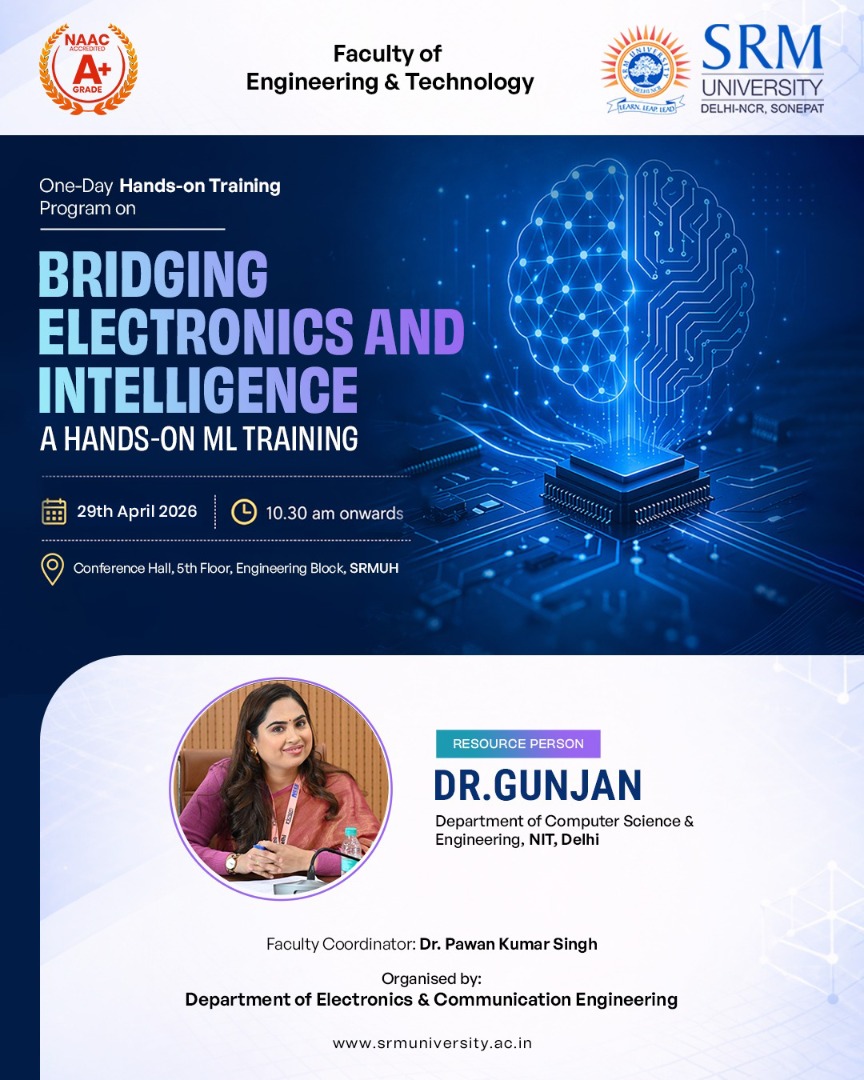
The Department of Electronics & Communication Engineering organized a hands-on activity titled “Bridging Electronics and Intelligence: A Hands-on ML Training for Students” with the objective of introducing students to the fundamentals of Machine Learning (ML) and its applications in modern electronic systems. The activity aimed to bridge the gap between traditional electronics engineering and emerging intelligent technologies by providing practical exposure to ML concepts, tools, and techniques.
The training session enabled students to gain firsthand experience in data handling, model development, and implementation of machine learning algorithms through interactive demonstrations and guided exercises. The event served as a valuable platform for enhancing technical skills, fostering innovation, and encouraging students to explore the growing intersection of electronics, artificial intelligence, and data-driven technologies.
Objectives of the Training
- To introduce students to the fundamentals of Machine Learning and its significance in modern engineering applications.
- To provide hands-on experience with basic machine learning tools, techniques, and workflows.
- To demonstrate the integration of Machine Learning concepts with electronics and communication systems.
- To enhance students’ analytical and problem-solving skills through practical exercises and real-world examples.
- To encourage innovation and interest in emerging technologies such as Artificial Intelligence, Data Science, and Intelligent Systems.
- To familiarize students with the process of data collection, preprocessing, model training, and performance evaluation.
Overview of the Training
The hands-on training program, “Bridging Electronics and Intelligence: A Hands-on ML Training for Students,” provided participants with a comprehensive introduction to Machine Learning (ML) and its applications in modern engineering systems. Conducted by Dr. Gunjan from NIT Delhi, the session was designed to combine conceptual understanding with practical implementation, enabling students to gain valuable exposure to intelligent computational technologies.
The training covered the fundamental principles of Artificial Intelligence and Machine Learning, including supervised and unsupervised learning techniques, classification, regression, clustering, and model evaluation methods. Participants were introduced to the complete machine learning workflow, starting from data collection and preprocessing to feature extraction, model training, testing, and performance analysis.
A significant component of the program focused on hands-on implementation, where students worked with real-world datasets and machine learning tools to develop and evaluate predictive models. Through guided coding exercises and practical demonstrations, participants gained experience in applying machine learning techniques to solve engineering problems.
The session also highlighted the integration of Machine Learning with Electronics and Communication Engineering applications, including smart sensing systems, predictive maintenance, intelligent automation, signal processing, IoT-enabled devices, and AI-driven electronic systems. The interactive nature of the training encouraged active participation, critical thinking, and technical discussions, helping students understand the relevance of intelligent technologies in contemporary engineering practice.
Overall, the training successfully enhanced students’ technical competencies, practical skills, and awareness of emerging opportunities in the fields of Machine Learning, Artificial Intelligence, and intelligent electronic systems.
Conclusion
The hands-on activity “Bridging Electronics and Intelligence: A Hands-on ML Training for Students” successfully achieved its objective of introducing students to the fundamentals and practical applications of Machine Learning in engineering. The training provided participants with valuable insights into modern AI and ML technologies while equipping them with hands-on experience in implementing machine learning models using real-world datasets and tools.
The session enhanced students’ understanding of the growing role of intelligent systems in Electronics and Communication Engineering and related disciplines. Through interactive discussions, practical exercises, and expert guidance, participants developed greater awareness of emerging technological trends, research opportunities, and industry requirements in the field of Artificial Intelligence and Machine Learning.