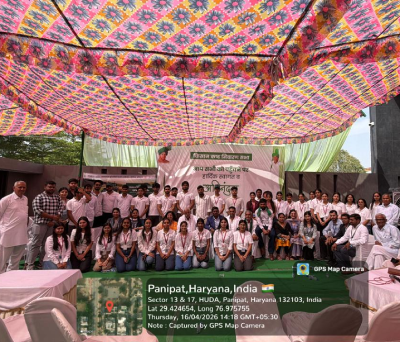
A Farmers Visit Interaction Meet aimed at empowering farmers through knowledge,
innovation, and collaboration was successfully conducted on 15 th April 2026 at Panipat,
Haryana. The event brought together farmers, students, academicians, and agricultural
experts on one platform to understand the real challenges faced by the farming community
and to identify practical solutions.
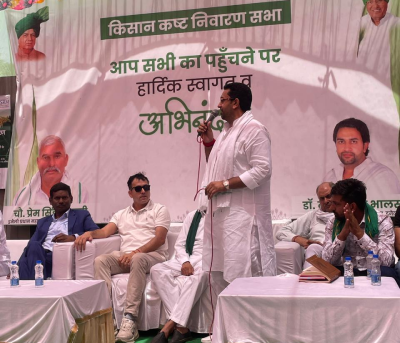
Dr. Naveen Nain Bhalsi, who played a key role in coordinating the event and ensuring
meaningful engagement between all participants, efficiently managed the programme. A
large number of farmers from villages in and around Panipat actively participated and shared
their concerns and experiences.
The event was chaired by Registrar Prof. V. Samuel Raj, SRM University Delhi-NCR, while
the programme was conducted under the guidance of Convenor Prof. Renu Choudhary, SRM
University Delhi-NCR, and Co-convenor Prof. Anjali Priyadarshini, SRM University Delhi-
NCR. Faculty Coordinators Dr. Swarnima Dey, SRM University Delhi-NCR, and Dr.
Poonam Bhatt, SRM University Delhi-NCR, also played a key role in coordinating the event.
Their collective efforts contributed significantly to the successful conduct of the programme.
Additionally, 51 Amrit Internship students from SRM University Delhi-NCR, selected under
the Amrit Internship Programme, enthusiastically participated in the programme.
The event commenced with a warm welcome to the dignitaries and participants. Dr. Naveen
Nain Bhalsi formally inaugurated the session and highlighted the importance of youth
participation in solving farmers’ issues.
Prof. V. Samuel Raj, Registrar, SRM University Delhi-NCR, addressed the gathering and
assured full institutional support to farmers. He emphasized that the university would assist
farmers through soil testing facilities to improve productivity, guidance from the Department
of Agriculture, crop advisory services, scientific farming techniques, and support in adopting
modern agricultural practices.
The event featured direct interaction between farmers, students, and experts, enabling on-
ground problem solving and practical guidance, while also exposing students to rural
agricultural realities. It further strengthened university-community collaboration and
generated awareness about government agricultural schemes. During the discussions, farmers
raised concerns related to crop and irrigation issues such as irregular water supply,
groundwater depletion, rising diesel costs for tube wells, pest attacks, and crop damage
caused by changing weather conditions. Concerns regarding MSP and mandi systems were
also highlighted, including delayed procurement, fluctuating market prices, mandi
deductions, and limited awareness about MSP benefits. Participants also discussed
government schemes and subsidies related to crop insurance, PM-Kisan benefits, fertilizer
subsidies, irrigation subsidies, and challenges in documentation processes. Experts
encouraged the adoption of sustainable farming practices such as organic manure and
vermicompost, crop rotation, water-saving irrigation systems, use of bio-fertilizers, residue
management instead of stubble burning, and integrated pest management.
The interaction session became the most engaging part of the event, as students directly
interacted with farmers and asked insightful questions regarding which crops provide the best
returns under Haryana conditions, the major challenges in wheat and paddy farming, ways to
conserve water in agriculture, whether farmers are receiving timely MSP benefits, the real-
life usefulness of government schemes, technologies that can reduce labour dependency,
methods to encourage youth participation in farming, and the benefits of diversification into
horticulture or dairy farming. Farmers honestly shared that while many policies appear
beneficial on paper, implementation delays, awareness gaps, and procedural barriers often
reduce their impact at the ground level.
The event was also graced by Mr. Amit Nain, who shared valuable insights on agricultural
practices in Australia. He explained the differences between farming in India and Australia,
highlighting large-scale mechanized farming systems, precision agriculture technologies,
efficient irrigation management, better farm-to-market logistics, the use of data-driven crop
planning, and a stronger emphasis on export-quality produce. He encouraged Indian farmers
and students to adopt modern innovations while preserving local strengths.
Manoj, chairperson Bharatiya Yuva Samiti enlightened participants on traditional and
modern agricultural practices followed in Haryana. He also discussed major government
policies and the practical challenges farmers face in availing their benefits.
As part of the field exposure programme, students visited the grain mandi of Panipat, where
they observed grain storage systems, auction and sale processes, transportation logistics, the
role of commission agents, price determination mechanisms, and challenges in post-harvest
handling. The visit provided students with practical understanding of agricultural marketing
systems and supply chain operations.
The Farmers Visit Interaction Meet proved to be a highly successful and impactful initiative
that bridged the gap between academia and the farming community. It offered students real-
world exposure while giving farmers a platform to voice their concerns and receive guidance.
The event reflected the commitment of SRM University Delhi-NCR, Sonepat and IPL
Foundation toward rural development, agricultural progress, and youth engagement through
the ICRO Amrit Internship Programme. Such initiatives are essential for building a future
where agriculture is more sustainable, profitable, and technology driven.